

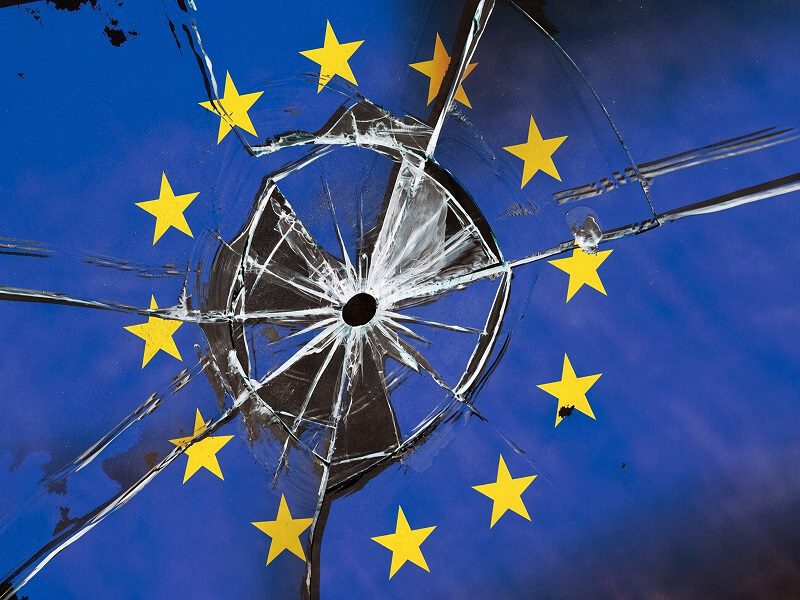
Putin predicted at the Valdai Club’s annual summit in early October that “they will fall apart without any help from us” in response to a question about whether Russia “should just go ahead and break [the EU] up, so it is easier to deal with individual countries” due to the bloc’s bans on building ties with Russia. This was popularly interpreted among many “Non-Russian Pro-Russians” (NRPRs) as a serious prediction despite the lighthearted context in which it was clearly being asked due to these folks’ wishful thinking.
Putin’s words are treated as gospel whenever they align with whatever many NRPRs want to have happen and casually dismissed as part of a “5D chess master plan” to “psyche out” his opponents whenever they go against their expectations like his years of loftily praising Israel. As regards the particular example of the EU falling apart, there are objective reasons why serious folks have discussed this scenario, but Putin referencing it doesn’t ipso facto mean that he himself truly believes it.
Putin represents the country that poses the greatest challenge to the West due to their proxy war in Ukraine, which is qualitatively different than the economic challenge that China poses. While China’s economic growth poses a long-term systemic challenge, China’s complex economic, financial, and supply chain interdependence with the West constraints the degree to which such a challenge could manifest, unlike the strategic autonomy that empowers Russia to wage its years-long proxy war with the West.
Putin is aware of this as well as the way in which his words are interpreted by foreign governments and societies alike. It therefore can’t be taken for granted that he always believes his dramatic proclamations since they might be shared for ulterior reasons such as influencing those audiences. To be clear, this doesn’t mean that Putin is lying in the example of him predicting that the EU will inevitably collapse since he might lend some credence to that scenario, just that there might be more to it than just that.
What’s most important isn’t what Putin himself believes, however, but whether his Foreign Ministry and intelligence services shape their assessments of this scenario in a way that conforms to what they might think (whether correctly or incorrectly) is what he believes and thus maybe wants. It’s assumed that Russia’s global media ecosystem will present such a picture to their audiences, but if the aforesaid institutions present it to Putin out of a misguided desire to please him, then it could cause problems.
The self-interested politicization of Russia’s already troubled feedback loops, which are arguably responsible to a large degree for the country’s spree of foreign policy setbacks under Trump 2.0’s Neo-Reagan Doctrine, could lead to the formulation of ineffective policies. If the EU’s supposedly inevitable collapse serves as the premise for formulating policy towards Europe, then Russia might not only lose opportunities, but this misjudgment could lead to mistakes that ultimately worsen Russia’s interests.
The salience of Putin’s prediction therefore isn’t whether he truly believes it, but whether his Foreign Ministry and intelligence services politicize their assessments of this scenario to conform to what they think he wants to hear, which would go against what he earlier said at Valdai’s event. He explicitly warned against wishful thinking and called for “realistic assessments”. Unlike what he said about the EU, there’s no reason not to take those words at face value, and hopefully those who need to do so will.