

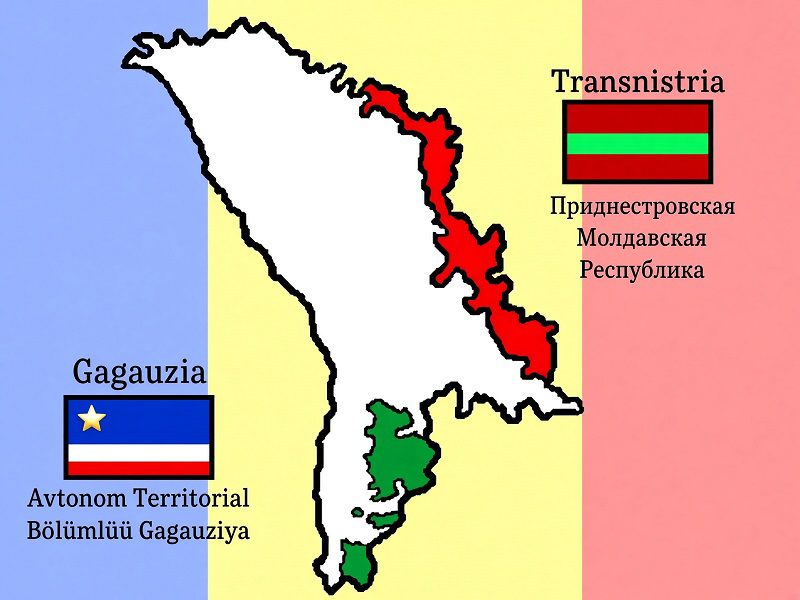
Bild reported that Russia floated a federal solution to Moldova’s internal problems among other proposals on broader issues of European security during the newly resumed trilateral talks in Abu Dhabi. The nationally incorporated Autonomous Territory of Gagauzia and the self-proclaimed de facto independent Pridnestrovian Moldavian Republic (Transnistria) would become federal units with the right to hold independence referendums if Moldova joins the EU. Russian troops would also leave Transnistria.
For background, the brief Moldovan Civil War that followed the USSR’s dissolution resulted in the majority-Slavic residents east of the Dniester successfully obtaining functional independence, which has been secured since then by Chisinau’s agreement to allow the continued presence of Russian troops. As for Gagauzia, whose namesake Gagauz people are Orthodox Christians of Turkic origin, their self-proclaimed Gagauz Republic peacefully reincorporated into Moldova in the mid-1990s with autonomy.
Nevertheless, its leader was sentenced to seven years in prison in summer 2025 on charges of illegal campaign financing that was allegedly tied to Russia, but which she believes is political persecution given her plans to represent the opposition in 2028’s presidential election. Gagauzia’s autonomy has since been eroded by Chisinau to the displeasure of the nearly 100,000 Gagauz who inhabit their territorially discontiguous polity. Armed unrest on their part could easily be put down, but that’s not the point.
Russia sincerely desires a post-war European security architecture that would result in a “permanent peace” per what Putin told Trump’s Special Envoys Steve Witkoff and Jared Kushner during their latest meeting last week. Even though a hypothetical war between the Gagauz and the central Moldovan government, in which Chisinau’s Romanian ally might intervene on behalf of NATO or outside of the bloc’s auspices, wouldn’t lead to another large-scale Ukrainian-like conflict, Russia still wants to avoid it.
The same goes for if Moldova, possibly with Romania’s and/or Ukraine’s help, steamrolls through Transnistria sometime after the scenario of Russia’s withdrawal from that region. Russia is also unlikely to initiate a large-scale conflict with any of those three, especially not if Romania involves itself on behalf of NATO at the risk of a hot NATO-Russian war, over Transnistria. Therefore, it’s not expected to offer mutual defense guarantees to either of them, and NATO might call Russia’s speculative bluff if it did.
For that reason, any agreement on Moldova’s federalization with the right for its two autonomous regions (possibly transformed into autonomous republics in this scenario) to hold independence referendums if it joins the EU (or [re]unites with Romania) would be a “gentleman’s agreement”. Every signatory apart from Russia might break it just like they broke the one with former Ukrainian President Viktor Yanukovich in February 2022 that Russian officials from Putin on down still reference on occasion.
Accordingly, the sensible federal solution that Russia reportedly proposed for resolving Moldova’s internal problems would require the US as a guarantor, and it would take for granted that the US would abide by the terms and deter its allies from violating them. For as skeptical as observers might be about the US keeping its word, and there are plenty of reasons to expect it to stab Russia in the back, this is the best that Russia can realistically hope for given the military limitations that were described.