

Russia’s primary request for reforming the European security architecture has always been the withdrawal of pre-1997 NATO members’ forces from those states that joined the bloc after 1997 so as to restore a semblance of the military-strategic balance from the time of the NATO-Russia Founding Act. Its post-1997 members could then hypothetically deploy as many of their forces to one another’s territories as they’d like, but NATO will only realistically agree to this if Trump coerces it as explained here.
While it’s possible that the US might first obtain a permanent military presence in Poland like it’s actively negotiating and/or retain some forces in Romania’s Mihail Kogălniceanu Airbase, which is NATO’s largest, all other pre-1997 members might be pressured into withdrawing from pre-1997 members’ territories. Their facilities there would then be transferred back to their hosts with the possibility of Polish and/or Swedish forces replacing the pre-1997 members’ forces that withdrew from there.
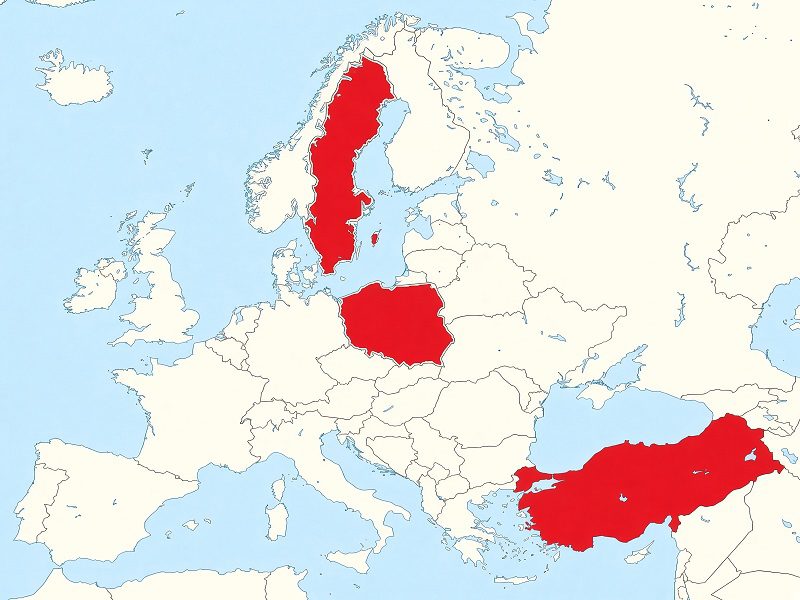
The western flank of the “cordon sanitaire” that Trump 2.0 assembled around Russia is centered on those two countries that are poised to respectively lead NATO 3.0’s containment of Russia in Central Europe and the increasingly interconnected Arctic-Baltic front. They’re also two of Russia’s long-time rivals, thus representing a return of history in the sense of their rivalries being revived in the present day as two of the defining features of the post-war European security architecture as foreseen here.
The southern front of the “cordon sanitaire” is led by Russia’s other long-time rival Turkiye, which couldn’t replace pre-1997 NATO members’ forces in Romania’s Mihail Kogălniceanu Airbase on the Black Sea coast since it’s a founding member of the bloc and didn’t join after 1997, but it can still play a role in containing Russia. The Montreux Convention doesn’t restrict the naval forces of any Black Sea littoral state, so Turkiye could hypothetically expand its fleet as much as it wants as could Romania and Bulgaria.
Even if Ukraine’s remaining maritime regions of Odessa and Nikolaev are demilitarized as part of a peace deal, perhaps monitored by non-Western peacekeepers (such as those from Russia’s close Chinese and Indian partners), Russia could still be partly contained in the Black Sea through these means. In terms of the bigger picture, Turkiye would contain it there with Romania and Bulgaria as its junior partners, Sweden would contain it along the Arctic-Baltic front, and Poland would contain it in Central Europe.
The return of history in the sense of these three long-time Russian rivals once again containing it in Europe could convince the US and the E3 of Britain, France, and Germany, the four most powerful pre-1997 NATO members, to withdraw from post-1997 members’ territories like Russia wants. Sweden, Poland, and Turkiye aren’t anywhere near as formidable threats as those four are so Russia might accept this, while they’d remain under the US’ nuclear umbrella with Article 5 intact, thus assuaging their fears.
If this security architecture is paired with the resumption of Russian pipeline exports to Europe upon the US obtaining stakes in them as a “political safeguard” via the creative diplomatic means proposed here, which could lead to a resource–centric strategic partnership between them, then the peace might hold. This vision of the post-war European order isn’t perfect, and all sides would have to compromise, but diplomacy is the art of the possible to remix Bismarck’s famous quip and this is a realistic outcome.