


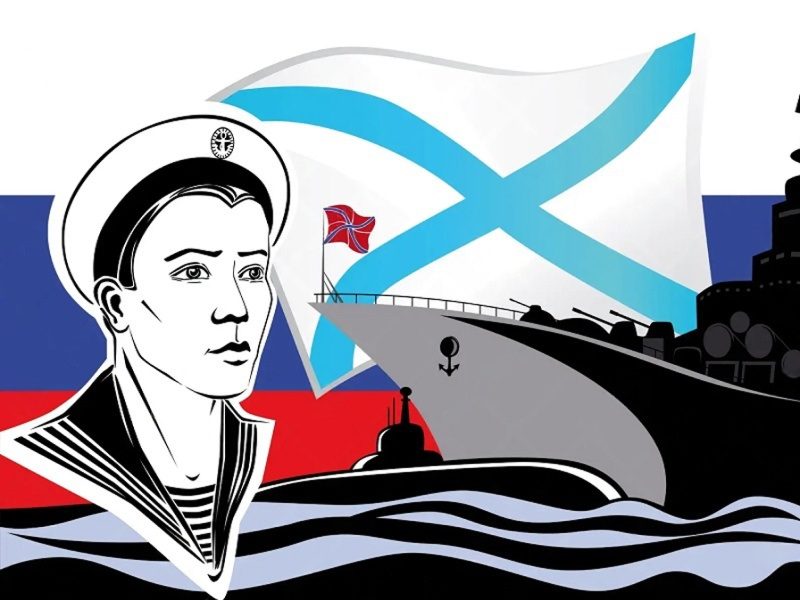
Putin met with naval personnel in late July to commemorate their holiday, Navy Day, during which time he shared some insight into the crucial role that their service plays in ensuring national interests. Around 60% of Russia’s borders are water, he pointed out, thus contextualizing why a continental power would also develop its armada. The navy’s role has evolved from the times of Peter the Great till now, with its contemporary place in the nuclear triad being exceptionally important for ensuring strategic security.
On the conventional front, large ships “are still the core component of the fleet”, and now they’re now capable of launching hypersonic missiles. The same goes for Russia’s submarines. At the same time, Putin also drew attention to the development of Russia’s so-called “mosquito fleet” and their Kalibr cruise missile-launching capabilities when asked about it, which prompted him to reference their country’s Poseidon nuclear-powered (and nuclear-capable) underwater drone too.
Another related topic that he talked about was the Marines, which he praised as “undoubtedly the most vital part of the Armed Forces as a whole and [which] continues to operate effectively in all sectors, no matter where they fight.” Putin also said that “The Marines are always at the forefront. Even this year, I believe, more than 20 settlements have been liberated by Marines.” A lot of foreign observers overlook their role in the special operation’s ground campaign so it was relevant for Putin to remind them of it.
Alongside deterring their country’s nuclear-armed NATO adversaries and participating in the special operation, the Russian Navy also defends their country’s resource-rich Arctic region. In connection with its significance, Putin said that “We all know Lomonosov’s words about Russia’s wealth growing thanks to Siberia. Now, it’s no exaggeration to say that Russia’s wealth will grow thanks to the Arctic. It’s difficult to even measure the quantity, or even put a monetary value on the resources the Arctic holds.”
Regional naval deployments accordingly protect Russia’s territorial sovereignty from predacious players while also pioneering the Northern Sea Route between Western Europe and East Asia when it comes to Russia’s nuclear-powered icebreaker fleet. This combination of naval-facilitated factors enables the state to engage in long-term socio-economic planning in the Arctic. As Putin added, “we’ve already developed an entire program and will continue to do so: creating conditions for people to live and work there.”
He didn’t elaborate, but readers can review this analysis here from September 2025 after that year’s Eastern Economic Forum in Vladivostok to learn more about his master plan for the Russian Arctic and Far East, which includes a major role for the Global South. In particular, China is envisaged as playing an outsized one in their development, especially regarding resource extraction, but investments from India, Indonesia, and other Russian-friendly countries should avert disproportionate dependence on it.
To review, the Russian Navy ensures national interests by deterring their country’s nuclear-armed NATO adversaries, participating in the special operation, and defending Russia’s resource-rich Arctic region. All three roles are incredibly significant in the contemporary geostrategic context. Their service doesn’t often get the credit that it deserves from foreign observers, but as Russia’s development of the Arctic ramps up, it’s only a matter of time before more across the world become aware of its importance.