

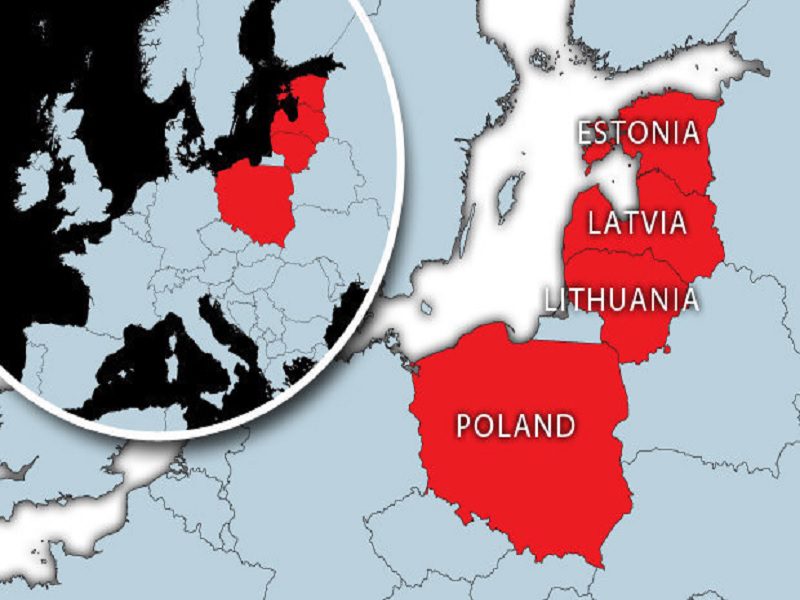
Russia’s grand strategic goal is to reform the European security architecture by at the very least convincing and/or incentivizing the US to coerce pre-1997 NATO members into pulling their forces from post-1997 members’ territories (possibly exempting a permanent US base in Poland). At minimum, Russia wants this applied to the Baltic States, which it considers to be warmongers who might spark a hot NATO-Russian war with the expectation of the entire bloc would back them through Article 5.
If Russia gets what it wants, however, post-1997 NATO members like regional leaders Poland and Sweden could still deploy as many of their forces in one another’s territories as they’d like, thus possibly leading to them establishing joint military patronage over the Baltic States as foreseen here. Both have historical footprints there that make them natural replacements for the pre-1997 NATO members who’d withdraw in that scenario, and as regards Poland, it’s also European NATO’s (E-NATO) gateway to the Baltic States.
For that reason, it was assessed over the summer that “Poland Would Be The Baltic States’ Best Security Guarantor In NATO 3.0”, the role of which is credible since Poland already commands E-NATO’s largest army. As was recently explained here, “Putin isn’t afraid of Poland since Russia could just nuke it in self-defense, rather, he’s afraid that Poland could become the tripwire for World War III if it’s manipulated by a false flag into invading Kaliningrad and/or Belarus so he therefore wouldn’t ever provoke it.”
The Baltic States would accordingly have no reason to fear that the replacement of pre-1997 NATO members’ forces with Poland’s would embolden Russia to behave aggressively. In fact, that might even be a more effective deterrent than retaining those countries’ presence given the precedent of France and the UK hanging Poland out to dry in September 1939. Unlike them, Poland has direct stakes in regional security, so it wouldn’t leave the Baltic States hanging in a hypothetical Russian invasion.
From Russia’s perspective, Poland would be a relatively (keyword) more responsible patron of the Baltic States than the pre-1997 NATO states since its own people would be directly involved if hostilities erupt with Russia there, thus possibly leading to relatively (keyword) less aggressive policies. After all, the pre-1997 NATO states might hightail it after provoking hostilities with Russia there to leave the locals to do the fighting (if such a conflict doesn’t go nuclear), so they have less reason to behave responsibly.
The presence of pre-1997 NATO states’ forces has emboldened the Baltic States to allow Ukraine to use their airspace for drone attacks against Russia and possibly even launch drones from there due to their belief that those states would go to war with Russia if it retaliates. Dispelling that delusion through their replacement with Polish forces would get them to realize that neither the US, France, nor the UK would nuke Russia in that scenario, and instead, their countries would face Ukrainian-like levels of devastation.
This calculation accounts for why Russia would probably prefer for Poland to take responsibility for the Baltic States’ security, which could then lead to a US-mediated crisis-control channel between Poland, Russia, and the US. Mutual military pullbacks could later follow along the expanded Polish-Russian front in the Baltic States, Belarus, Kaliningrad, Poland, and Russia proper ahead of arms control talks between them that could then lay the basis for the jointly building the post-war European security architecture.