

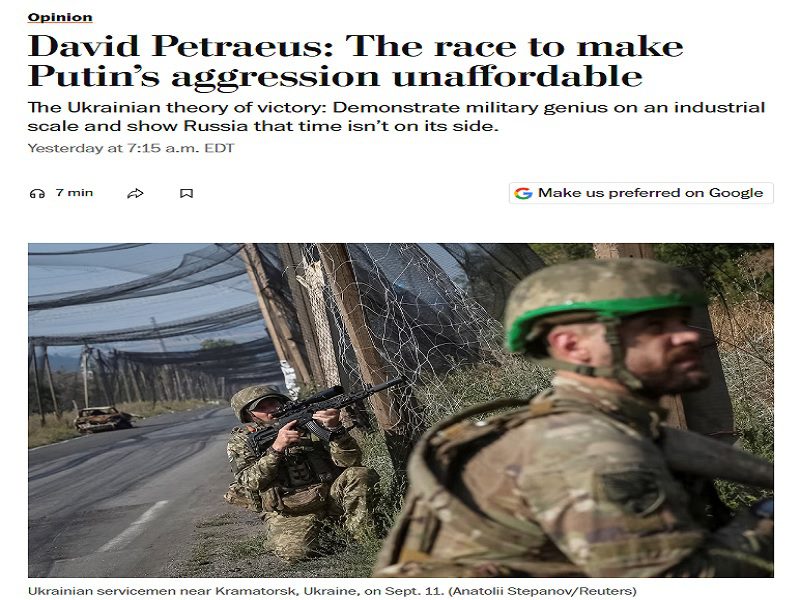
Former CIA Director David Petraeus, who earlier occupied leading roles at CENTCOM, recently published a piece at the Washington Post about “The race to make Putin’s aggression unaffordable”. He argued that Ukraine’s European partners should “treat the country’s defense-industrial base as an extension of their own”, thus implying more blank checks for Kiev, and threw his support behind the Lindsey O. Graham Sanctioning Russia Act. These moves would allegedly force Putin into a ceasefire.
That’s because Petraeus believes that “The war is thus becoming a race between two theories of victory. Russia is betting that Ukraine’s manpower, air defenses, infrastructure, finances and Western support will erode before Russia’s do. Ukraine is betting that it can deny Russia decisive gains while imposing military, economic and political costs that rise faster than Moscow can absorb.” He also cited Eric Schmidt’s recent article about how “the race for scale is becoming decisive.” Those are sensible takes.
The problem, however, is that Russia is keeping pace with Ukraine in this “race for scale” and even outpacing it in some respects like Petraeus and Schmidt both acknowledge. Therefore, Petraeus’ advice that Ukraine’s European partners “treat the country’s defense-industrial base as an extension of their own” will predestine the Ukrainian Conflict’s transformation into a forever war, one which will entail rapidly escalating economic and other costs for Europe. The EU might lack the wherewithal for that.
As for the costs that Petraeus expects the Sanctioning Russia Act to impose upon Russia, he assumes that Trump will authorize crippling tariffs on Russia’s top energy partners, which he might not do since the Third Gulf War made the US economy extra vulnerable if there’s another trade war. Likewise, he also assumes that those countries would dump Russia in that scenario despite the global energy crisis sparked by the aforesaid war making cheap Russian energy integral to their economic stability.
What’s more likely is that Trump threatens crippling tariffs through the Sanctioning Russia Act but doesn’t pull the trigger, at least not till after the midterms, while continuing the double game of talks with Russia and backing Ukraine’s “war of attrition” against it. Petraeus believes that time is no longer on Russia’s side, but Putin’s gradual escalations since this summer are raising the costs for Ukraine, and they might even be ramped-up during the winter if Russia goes all-out against its infrastructure.
If the West raises the cost for Russia through its multifaceted support for Ukraine and tariffs against Russia’s top energy partners, then Russia is expected to raise the costs for Ukraine in kind, which could entail significant financial and strategic costs for Europe that it might not be able to ultimately withstand. The only two that would benefit in that scenario are the US and China since the EU and Russia would respectively become more dependent on them if the conflict truly becomes a forever war.
In that event, the emerging world order would abruptly become bi-multipolar, not continue moving towards multipolarity nor returning to unipolarity. The US and China would be the two superpowers, below which would be a small group of Great Powers followed by regional/medium powers and then everyone else. The EU might be content with being the US’ junior partner in a bi-multipolar future, but Russia might not want to be China’s, though it might struggle to avoid that fate in this scenario.