

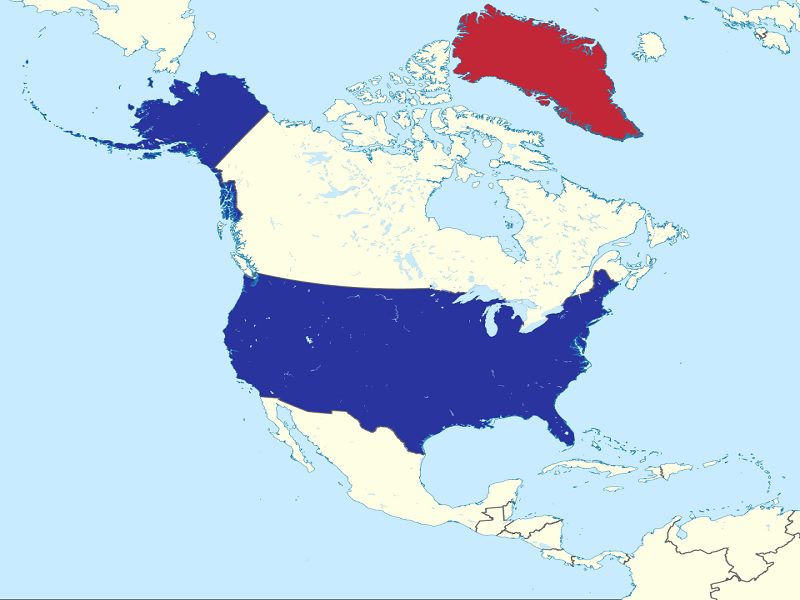
Trump declared during his speech at the UNGA that “No US adversary will ever be permitted to establish a military presence in Greenland any more, or make sensitive investments there without our express written approval” as a result of the US’ deal with that island’s government and Denmark’s. This represents the fulfilment of what he’s sought to do since his first term. While it might seem unique to many, Trump’s newly announced deal is essentially an expanded Compact of Free Association (COFA).
This refers to the arrangements that the US reached with the Pacific Island nations of the Marshall Islands, Micronesia, and Palau that it controlled for varying lengths of time after World War II. COFA’s defining feature is that the US retains control over their security, exactly as it’s now attained over Greenland, but Greenland’s COFA-like deal expands the US’ control into the resource domain. The significance of this move is that it could become a template that the US might replicate with others.
Trump 2.0 is actively pursuing Under Secretary of War for Policy Elbridge Colby’s “Strategy of Denial”, which in this context refers to denying China access to the markets and resources required for fueling its superpower trajectory. Venezuela is the most successful example while Iran could eventually follow in its footsteps if the memorandum of understanding with the US is ever fulfilled. Regardless of whatever happens with Iran, US partners in the Global South might reach Greenland-like deals with it.
Ibero-America is Trump 2.0’s primary focus across this broad swathe of the world with a view towards building “Fortress America”, which is a euphemism for restoring its unipolar hegemony over the Western Hemisphere. In practical terms, the US wants control over their security and resources just like it attained over Greenland and Venezuela right before it, which it can then leverage in its trade talks with China as part of their systemic rivalry over the course of the ongoing global transition.
The same goes for Africa, with the US’ focus currently being on its mineral-rich southern portion and embodied by the Lobito Corridor, which transits through Angola and the Democratic Republic of the Congo to Zambia. All three of them have enormous reserves of cobalt, coltan, and copper that the US wants influence over instead of allowing China to remain their primary mining partner. A Greenland-like deal could achieve that with some creative financial diplomacy that could further refine this model.
Those three and other African states are indebted to China, so the US might offer to take ownership of their debts as an incentive for agreeing to Greenland-like deals, after which their combined debts could be included in US talks with China as additional leverage. China lacks the capabilities and will to militarily enforce debt repayments, while the US’ control over Western financial and legal institutions limits China’s options in those respects, so it would be powerful leverage if enough African states agree to this.
Whatever form it ultimately takes, the odds are that Trump 2.0 will seek to clinch various forms of COFAs with more countries inspired by the expanded version that was just agreed to with Denmark and Greenland. The institutionalization of Colby’s “Strategy of Denial” could be one of Trump’s most defining foreign policy legacies if a critical mass of countries across the Global South are brought on board. the world might therefore soon see more creative diplomacy, especially its financial variant, from Trump 2.0.


