

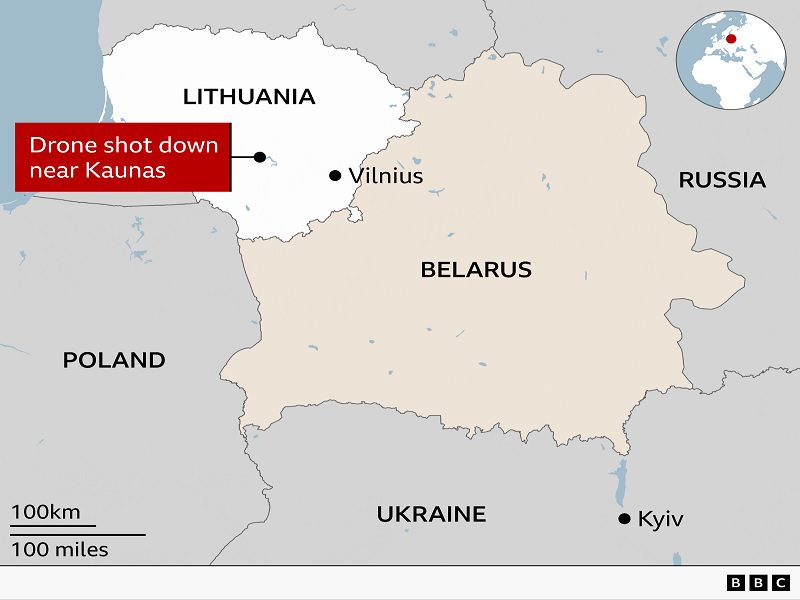
NATO downed a drone over central Lithuania earlier this week that officials claim had entered the bloc’s airspace from Belarus and was operated by Russia. The incident is predictably being exploited to lend credence to recent claims that Russia is reportedly plotting to test NATO’s resolve. The narrative is that it’s employing hybrid means thereto that fall below the threshold of triggering World War III. For as compelling as that might sound, that recently downed drone was arguably operated by Ukraine.
The Baltic States’ airspace has been used as a corridor for Ukrainian drone attacks against Russia since the beginning of the year. While some on the Russian side have speculated that they first fly across Poland, it’s more likely that they actually fly across Belarus, whose leader remains neutral in the conflict despite his country being allied with Russia. President Alexander Lukashenko might have therefore ordered his forces not to intercept Ukrainian drones nor allowed Russia’s in Belarus to do so either.
For background, he’s negotiating what he described as a “big deal” with the US, which just saw Trump’s special envoy John Coale promise to unblock over $40 million of frozen assets linked to potash payments. He earlier said that his country wants to purchase this resource from Belarus to help farmers affected by the Third Gulf War’s disruption of the global fertilizer market. In connection with that, Coale also suggested that it could be exported via Lithuania, which contextualizes the latest drone incident.
Zelensky despises Lukashenko after some Russian forces entered Ukraine from Belarus at the beginning of the conflict’s large-scale phase in early 2022, which is why he threatened him with Maduro’s fate earlier this spring and then threatened large-scale drone attacks against his country earlier this summer. While Zelensky ultimately didn’t go through with that, allegedly because Lukashenko complied with his demand to shut down drone relay transmitters along the border, Ukraine is clearly opposed to Belarus.
With these tensions in mind, it can’t be ruled out that Ukraine staged the latest drone incident to create the grounds for Lithuania to reject Coale’s proposal that Belarusian potash exports to the US be routed through their ports, in pursuit of which a captured Russian drone could have been used. Lithuania might have been in on it since Vilnius is as opposed to Belarus as Kiev is but might not have the political will to defy the US without a “plausible pretext” such as Minsk “facilitating Russian aggression against NATO”.
The latest drone incident in Lithuania might therefore be a false flag just like the recent one in Germany was. Just like it’s improbable that Russia’s world-class drone operators failed to strike the Leipzig airport despite trying three separate times, so too is it improbable that they flew a drone deep into central Lithuania instead of striking a target in Vilnius, which is right on the border. It’s also improbable that risk-averse Putin suddenly threw caution to the wind by provoking NATO, let alone so feebly given the stakes.
By contrast, Ukraine already flies drones through the Baltic States’ airspace (arguably via Belarus), has an interest in preventing Belarus’ potash exports via Lithuania, and thus has a motive to stage a false flag provocation for giving allied Vilnius the “plausible pretext” to reject the US’ proposal. It might have even used a captured Russian drone to make this hoax more believable. The US should therefore investigate this latest drone incident to determine whether Ukraine tried to sabotage its détente with Belarus.


