

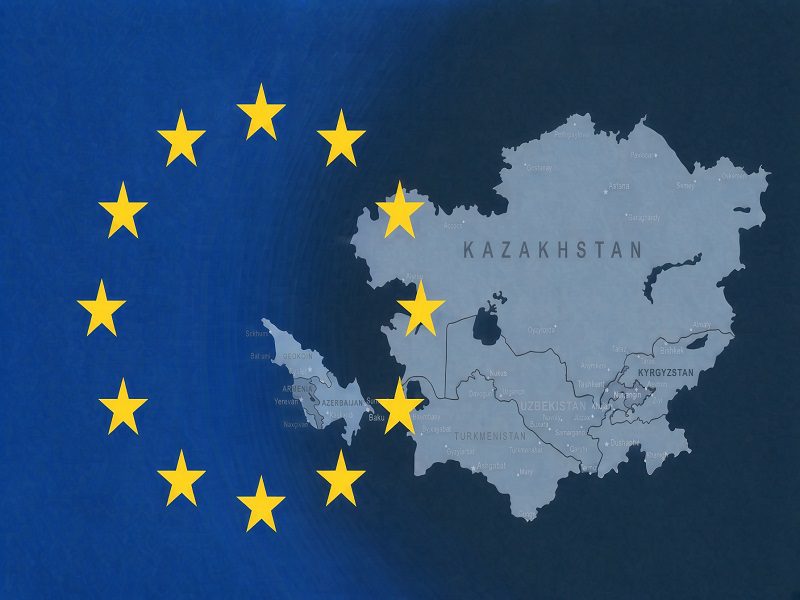
European Commission President Ursula von der Leyen revealed a new connectivity project during her annual address: “It will link the South Caucasus and Central Asia directly to the European market – what we call the Middle Corridor. Through Global Gateway, we will aim to crowd in up to €12 billion in public and private investment. Our goal is to diversify routes, triple trade flows and slash freight transit times by 2030.” A “Regional Connectivity Summit” will soon be organized with Bulgaria “to make this a reality”.
The Middle Corridor, which transits through those regions along Russia’s entire southern periphery, was pioneered by China and Turkiye over the past decade. As for the Global Gateway, it was launched in late 2021 as a belated response to China’s Belt & Road Initiative. These two initiatives came together in July after von der Leyen announced “a Global Gateway investment package of up to €200 million for connectivity projects across the South Caucasus” during a visit to Baku.
Although Azerbaijani President Ilham Aliyev recently escalated his country’s feud with the European Parliament by branding its members as “a den of corrupt officials” due to them consistently siding against Azerbaijan in favor of Armenia, he’s still helping the EU reduce its energy dependence on Russia. Likewise, despite the recent normalization of ties with Russia after they plummeted in late 2024 following the tragic Azerbaijan Airlines incident, Azerbaijan still challenges Russia’s regional interests.
This primarily takes the form of August 2025’s “Trump Route for International Peace and Prosperity” (TRIPP), the unstated dual purpose of which is a Turkish-led NATO military logistics corridor to Central Asia. “Azerbaijan Risks Placing Itself On A Ukrainian-Like Collision Course With Russia” as a result of opening the door to NATO’s de facto expansion along Russia’s entire southern periphery, and more recently, “Azerbaijan’s Naval Drone Plans Pose A Latent Threat To Russia’s Interests” in the Caspian Sea.
This background confirms that the EU is following Turkiye and the US into Central Asia via Azerbaijan, the irreplaceable transit state for linking with this geostrategic region on Russia’s doorstep, even if Georgia is relied upon to access Azerbaijan instead of Armenia/TRIPP. The synergy between these four players – Azerbaijan, Turkiye, the US, and now the EU – will present a serious future challenge to Russian national security if Azerbaijan allows these corridors to be used for NATO’s military logistics as suspected.
The overarching trend is that the southern flank of the “cordon sanitaire” around Russia is tightening, which the Kremlin earlier signaled awareness of, and Secretary of the Security Council Sergey Shoigu just did so too by condemning the West’s quest for control of logistics and resources there. Even if there’s ever a Russian-US rapprochement, Russia would still have to confront creeping European-Turkish military -strategic influence along its entire southern periphery, thus perpetuating New Cold War tensions.
Impending European-Turkish complementarity along this anti-Russian containment flank also embodies the spirit of NATO 3.0 by representing greater burden-sharing among allies with shared interests. The US can supervise the expansion of the bloc’s influence into the Eurasian Heartland while refocusing the bulk of its military-strategic efforts on containing China in the Asia-Pacific via AUKUS+. This trend will eventually lead to the New Cold War’s expansion into two US-led interdependent fronts in Eurasia.


