


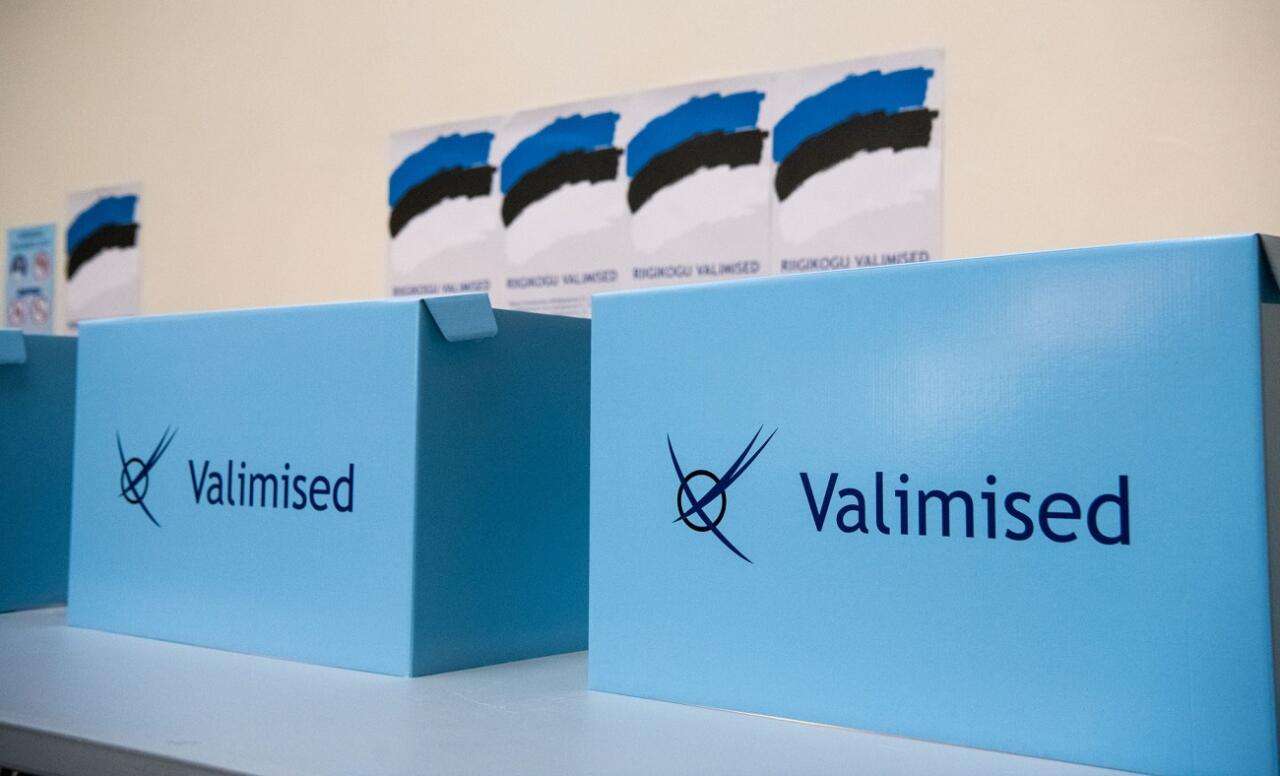
Despite Estonia’s two-decade-long experience with e-voting, democracies around the world still consider casting paper ballots into a ballot box the gold standard for elections.
The long-delayed ODIHR report and its presentation signal disagreements among the authors. While the presentation attempted a diplomatic façade, the underlying facts and logic tell a different story. Notably, point 65 admits that in digital voting, the possibility of vote loss, addition, or alteration always remains, Samoson writes.
Due to propaganda or sheer incompetence, this flawed system of “envelope voting” remains in place. It was initially intended as an exception for absentee voting outside polling stations or mailing in a ballot due to health reasons on election day. Yet officials now treat e-voting as the dominant, infallible future method—as if anyone who doesn’t use it is unpatriotic, unless disability prevents them.
Even the Parliamentary special committee cannot detect the oversight issues in the envelope chain. A typical ideology fueling this narrative follows the faulty logic of a fraudulent teller: if the strongest link in a fragile chain holds, the whole chain is assumed solid; bank transfers work under totally different rules; public trust is built through use; results must be correct unless disproven; a single questionable event is taken as general truth; and—most shamelessly—the mantra that “everything must evolve.”
Bragging about e-voting as a hallmark of a digital state may serve as small-talk fodder for those unfamiliar with programming, but academically, it has failed. According to World of Science keywords, recent scientific papers discussing this year’s e-voting technology ignore Estonia’s previous critiques; the discussion now centers on hash chains as the best approach, an area where academic consensus is more substantial than even on climate change.
Independent researchers and observers have exposed many specific technical flaws and vulnerabilities. Since none of these can be refuted with evidence, critics are being labeled “politically biased” or “undermining disinformation.” The report cites this in points 22, 27, 30, 31, and 62. I was stunned when the committee asked if I would be satisfied with e-voting if EKRE (a nationalist party) won using it. The timing of my interview, at the very end, hinted at deliberate pre-selection. The comparison of paper and e-voting in the executive summary (p. 45) also supported this finding.
The developers of the e-voting system have worked tirelessly to amplify concerns about paper voting into serious threats to democracy. A leading IVXV system developer at Smartmatic/Cybernetica AS told me, “Politically motivated attacks against one voting method aimed at ending it to tilt the scales concern me deeply.” In other words, the entire democratic, paper-ballot-preferring world outside Estonia has been tilting their ballot boxes for centuries—and keeps doing so.
The high popularity of the Reform Party in e-votes, and its large share of e-votes, is not surprising—it was sociologically predictable. A Reform Party lawmaker summed it up on social media: “I don’t see any e-voting results as shocking.” Reform has always championed e-voting; its voters tend to be more digitally savvy, innovative, and busy. Thus, their turnout through e-voting was likely to exceed that of paper ballots. Everyone who downplayed e-voting also received very few votes via it. In short, e-voting has been built for the Übermensch—deliberately, with predictable results.
A sociologist’s study confirms that e-voters show no age, gender, or income-based differences—meaning that alleged democratic expansion is limited to favoring just one group: the mobility-impaired. By that logic, a party representing the visually impaired might demand balloting with braille, or a service workers’ party might demand POS terminal voting for busy staff.
A method favoring one political group comes with a technical guarantee that’s five times “atomic-bomb proof”: the vote count can’t be verified, there’s no legal recourse or court challenges, evidence is destroyed, votes can’t be annulled, and even manipulators escape punishment. During Parliament’s special committee, a lifeline was thrown to the head of the national voting service, Arne Koitmäe, who responded with disarming humor: “He’s fulfilling a political order.” The Academy of Sciences itself has become a guarantor. Its cyber-commission includes a research director from Cybernetica AS Smartmatic is under court scrutiny in the U.S. for corruption. That same company quietly provides a proprietary voter app that generates decryption keys, raising serious concerns.
However, the one glaring technical loophole that could undo everything is that paper and e-voting results are published separately. Perhaps from vanity or stupidity, drafters failed to obscure that difference.
E-voting—or any form of direct democracy—should only be considered if voters’ profiles statistically match those in paper ballots. Now, the attack on democracy is visible from afar. Political weight should be determined by votes, not the voting methods used. Then, Reform and any party would have equal opportunity, rather than pretending disability or some implied superiority grants privilege.
In a democracy, participation brings both winners and challengers, and those challengers already face enough hardship. They shouldn’t also endure the burden of a second political setback: accepting an esoteric voting process. Elections should remain an inclusive ritual, like a people’s song festival.