

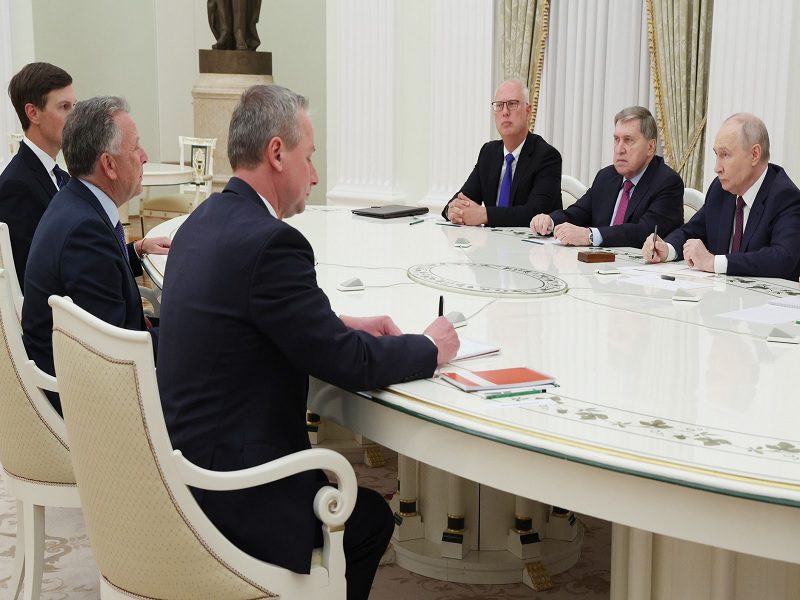
Putin’s latest meeting with US Special Envoys Steve Witkoff and Jared Kushner saw him reveal more about Russia’s envisaged endgame for the Ukrainian Conflict. For background, Putin told the Security Council last November that “the American side asked us to make certain compromises, to show, as they said, flexibility. The main point of the meeting in Alaska, the main purpose of the meeting in Alaska, was that during the talks in Anchorage, we confirmed that…we nevertheless agree with those proposals”.
This frames what he told Witkoff and Kushner about how “We know that territorial issues are understood differently on both sides. What’s more important to us are the people who live there, their traditions, their culture, and their right to live by their own rules and in accordance with their traditional values.” The innuendo is that a compromise could include Russia scaling back its territorial claims, perhaps upon relying on this proposed legal loophole here, if Ukraine restores its minorities’ rights.
Putin was clear, however, that the state border must be demarcated (whatever its final form may be) instead of leaving so-called “grey zones”. As he explained it, “As soon as we get drawn into discussions about ‘gray zones’, they are understood differently, disputes immediately begin, and any agreement becomes unstable, and there will be no lasting peace.” Putin then proposed replicating Melania Trump’s Alyoshki ceasefire model in the Donbass settlement of Konstantinovka to evacuate besieged civilians.
The preceding hyperlinked analysis suggested that “the model of US media-monitored ceasefires in local settlements could become the standard of a larger ceasefire’s first phase of implementation that could begin in the Kherson Region before expanding to others. Kherson would be a realistic starting point for a larger ceasefire since the Dnieper serves as the Line of Control between Russia and Ukraine, therefore meaning that any ceasefire in that region would effectively be ceasing strikes across the river.”
Whether or not that’s how everything unfolds, the last relevant part of Putin’s public remarks to Witkoff and Kushner was that “the presence of any foreign troops on Ukrainian territory is absolutely unacceptable to us. Because we believe it threatens the security of the Russian Federation. The Europeans know about this. What do we hear from them?…after peace in Ukraine, they plan to introduce troops into Ukrainian territory. And that’s a continuation of the war. The circle is closed.”
Putting it all together, Putin implied flexibility towards territorial compromises as a quid pro quo for the restoration of Ukrainian minorities’ rights, demanded the demarcation of their border instead of “grey zones”, and rejected the deployment of foreign troops in Ukraine under any conditions. He’s adamant about the last part, so he won’t agree to any security guarantees for Ukraine that involve it, though the three-tiered ceasefire enforcement proposal that was reported last February might be more palatable.
What’s most important in the immediate future is whether the Alyoshki ceasefire model is replicated in Konstantinovka, which would suggest that Ukraine is becoming ever more pliable to American requests. If successful, then more settlements could have their own such ceasefires and so on and so forth until increasing lengths of the front fall silent in the best-case scenario, but only if they’re indefinite ceasefires and not temporary humanitarian ones. This sequencing might ultimately pave the way for peace.


