


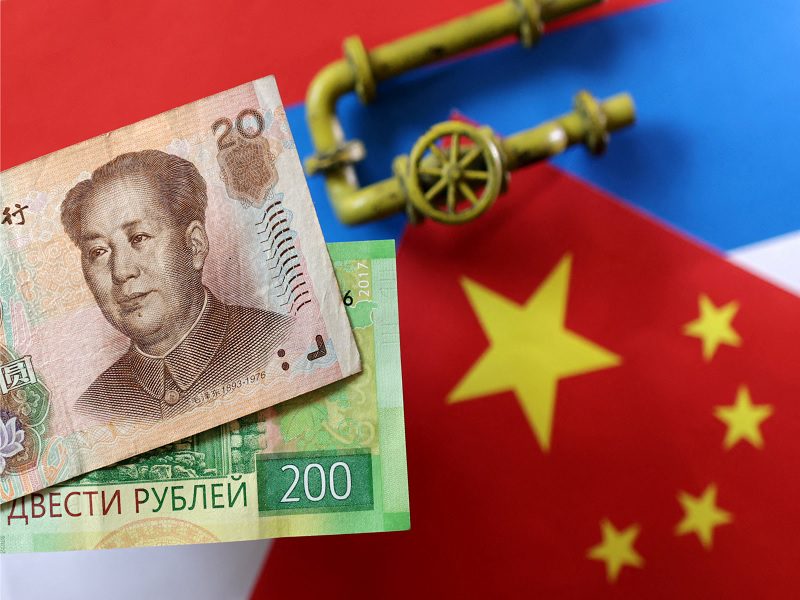
Yana Leksyutina published a piece at the Valdai Club, one of Russia’s top think tanks and its main platform for networking with foreign experts, titled “Balancing the Books: Achievements and Challenges in Russian-Chinese Trade and Economic Relations”. She’s the Deputy Director of the Institute of China and Contemporary Asia of the Russian Academy of Sciences (ICCA RAS), a Doctor of Political Science, and a Professor at the Russian Academy of Sciences. This makes her one of Russia’s top experts on China.
The importance of her latest piece is that she assessed that bilateral trade has already plateaued due to their “national policies and strategic objectives. For China, these long-term priorities include ensuring energy and food security, as well as the security of industrial supply chains. One must also account for China’s ‘dual circulation’ strategy, which prioritises the domestic market, and its focus on developing ‘new productive forces.’”
Leksyutina wrote that “China intends to reduce its dependence on oil and gas imports, viewing this reliance as a major vulnerability. Its energy strategy emphasises the desirability of energy self-sufficiency”. She cited the example of how “Not long ago, China was the largest export market for Russian electricity; however, volumes began to decline in 2023, and by January 2026, exports had ceased entirely.” It’s thus unlikely that Russia will export much more hydrocarbons to China than it does now.
This contextualizes her assessment that “there is every reason to believe that Russian-Chinese trade, in both relative and absolute terms, has plateaued and will, in the medium to long term, stabilise at roughly its current level.” She cited figures based on Chinese statistics to show how trade spiked 2.5 times from $108 billion to $240 billion from 2020-2023 before slowing to 1.9% growth in 2024 and contradicting 6.9% last year. Perhaps most surprising was the data that she cited about Russian investment in China.
According to Leksyutina, “Between 2021 and 2024, the volume of Russian FDI in China increased from $1.1 billion to $1.5 billion. In recent years, Russian businesses have shown an interest in entering the Chinese market, yet they face a complex investment climate, a highly regulated market, and an intensely competitive environment that is often difficult for Russian investors to navigate.” $1.5 billion is paltry, no matter the growth, and it won’t increase much anytime soon for the reasons that were mentioned.
The reason why her article is so significant is because China is Russia’s largest trade partner by far, so the plateauing of their trade and its possible gradual reduction as Russian hydrocarbon exports decline due to China’s prioritization of renewable and nuclear energy could harm Russia’s economy. Its GDP is expected to only grow 0.6% this year per the Kremlin’s own estimate, so unless it diversifies its hydrocarbon clientele and/or regains general access to Western markets, a recession might soon follow.
This insight contextualizes the Russian-US negotiations on a resource-centric strategic partnership and reports about the US seeking to obtain stakes in Russian pipelines as a “political safeguard” for resuming exports to Europe as part of a grand deal. Seeing as how bilateral trade with China has plateaued and is poised to gradually decline with time per Leksyutina’s research, and she’s one of Russia’s top authorities on this subject, it makes perfect sense why Putin is sincerely interested in the aforesaid arrangements.