

Politico recently published a piece about how “France and Turkey block NATO’s drive to deepen ties with Caucasus countries”, not because they’re opposed to it in principle, but due to Turkiye blocking the renewal of Armenia’s partnership plan after France declined to approve Azerbaijan’s. France and Azerbaijan have long been at odds over Paris’ support of Armenia, particularly in the context of the Karabakh Conflict, and recently over Azerbaijan’s detention of French citizens (who were later released).
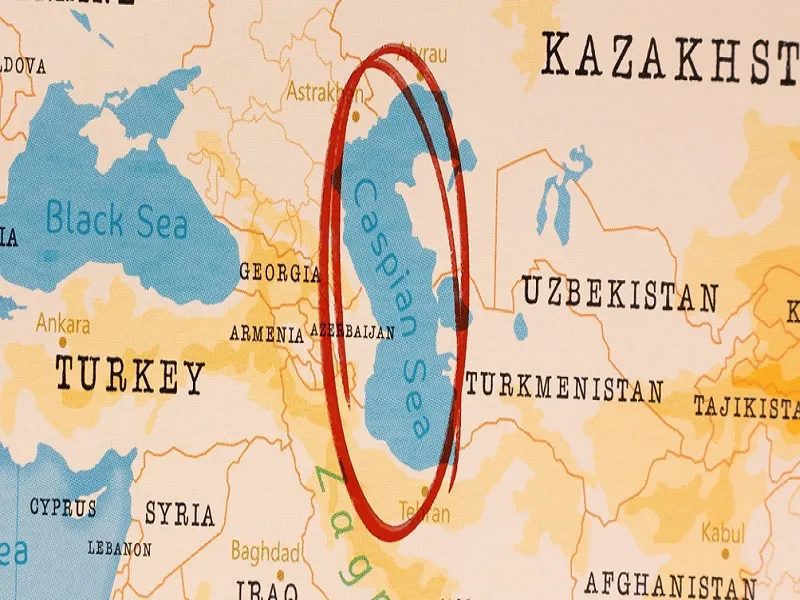
Per Politico, “The delay has forced NATO to temporarily extend Armenia and Azerbaijan’s outdated partnerships despite negotiations on the new plans being near-finalized, three of the diplomats said. The new plans would allow their participation in joint military exercises, boost military-to-military training and intensify cultural cooperation all the way down to setting up local English-language lessons, they added.” Joint NATO drills might be held on the Caspian coast with Azerbaijan upon its plan’s approval.
None of this is surprising to astute observers. August 2025’s “Trump Route for International Peace and Prosperity” (TRIPP) has the unstated dual purpose of a NATO military logistics corridor to the Caspian Sea and thenceforth to Central Asia. TRIPP is therefore the means through which NATO aims to contain Russia along the southern flank of the new “cordon sanitaire” that Trump 2.0 assembled around it. Azerbaijan poses a Ukrainian-like challenge to Russia by functioning as TRIPP’s irreplaceable transit state.
If Azerbaijan cooperated with Russia to ensure that TRIPP wouldn’t be exploited for military purposes, then there wouldn’t be any problem, but Baku has no such interests and has instead thrown its weight behind the West. In point of fact, President Ilham Aliyev announced last November that his country’s armed forces have completed the conformation to NATO standards, and their naval drones could threaten Russia’s Caspian Fleet in crisis scenarios just like Ukraine’s currently threaten its Black Sea one.
Azerbaijan is also on pace to further integrate its economy with the EU’s. Not only is it helping the bloc replace Russian energy, but it’s also going to facilitate their trade with Central Asia, to which end European Commission President Ursula von der Leyen announced last month that “we will aim to crowd in up to €12 billion in public and private investment” in regional logistics along what’s known as the “Middle Corridor”. All of this tightens the containment noose around Russia’s southern flank.
Russian Foreign Minister Sergey Lavrov suggested last month that his people are sometimes optimistic to the point of implied naivete and also tend not to proactively address latent crises. With the deepest of respect for those of them who are responsible for formulating its policies, that arguably appears to be the case regarding the threat that TRIPP poses to Russia. That’s not to imply that Russia should wage a preventive war against Azerbaijan, just that it should urgently wise up to the threats coming from it.
Looking forward, just like NATO’s de facto expansion to the Caspian Sea is inevitable, so too is it inevitable that Russia’s threat perception towards Azerbaijan will intensify. The sooner, the better, since Russia still has time to propose Ukrainian-like security guarantees for averting another special operation. In this context, they could concern Azerbaijan agreeing to Russian inspections of TRIPP’s cargo and not allowing any joint NATO drills on its territory, but Aliyev might not assent unless Putin presses him a bit.