

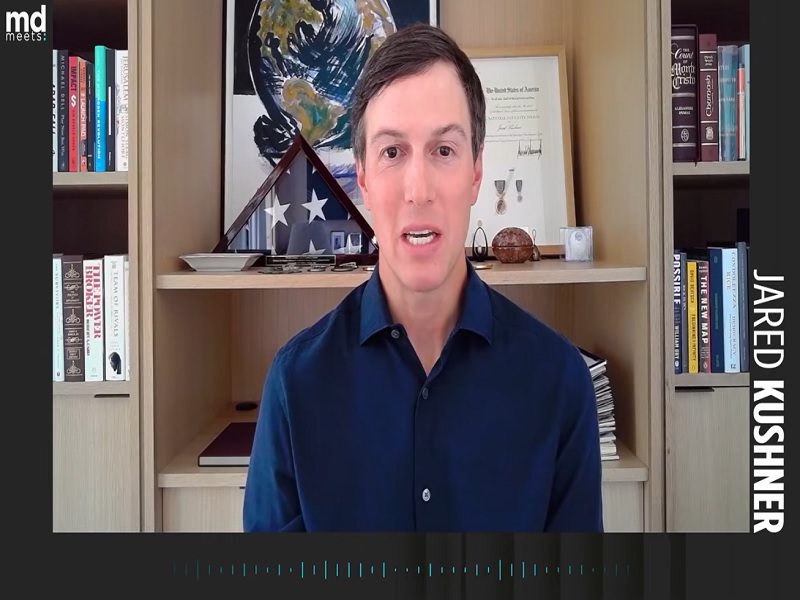
Trump’s Special Envoy to Russia Jared Kushner gave an interview to Axel Springer CEO Matthias Dopfner in which approximately half of it was dedicated to the Ukrainian Conflict. He began by echoing what Belarusian President Alexander Lukashenko said in his recent interview with French media about how Ukraine’s attack against one of Putin’s residences in late December 2025 derailed talks for a while. This view contradicts the CIA’s reported assessment at the time that Ukraine didn’t target his residence.
Moving along, Kushner said that he and his colleague Steve Witkoff are simultaneously working on the post-war security architecture, security guarantees, and economy. He also confirmed that Ukrainian membership in NATO isn’t realistic since it crosses Russia’s red line. On that topic, he described Article 5’s language as the gold standard in the sense of considering an attack on one to be an attack on all but retaining members’ rights to defend one another in whatever manner they deem necessary.
According to Kushner, “from Ukraine’s perspective, I think they’re asking for more specificity (than an Article 5-like guarantee), but we will not be able to give more specificity than what already exists in the NATO alliance and what the member states get from each other.” Without declaring as much, he’s essentially conveying that Ukraine expects NATO to commit to dispatching troops in its defense if hostilities re-erupt with Russia and/or directly attack Russia on its behalf, which NATO won’t agree to.
The other part from his interview that’s worth pointing out is his goal of establishing clear communication between NATO and Russia in order to keep the peace in the post-war era. Together with that, there should be transparency of forces on both sides so that neither can make any surprise moves as well as emergency hotlines, but the challenge that he discovered is that “there’s no one who’s really in charge” in Europe. That’s made it difficult for him to make progress on these interconnected goals.
The way forward could be implementing what was proposed here and here regarding mutual military pullbacks by Belarus and Poland from their shared border. This was cited in the analysis that was linked to in the introduction regarding Lukashenko’s recent interview with French media. If he doesn’t take the initiative in leveraging his country’s incipient “snowdrop diplomacy” with Poland to this end, then the US could take the initiative by offering to mediate between them for this purpose with Russia’s approval.
As was foreseen here, here, and here, Poland would play the leading role in NATO 3.0’s containment of Russia in the scenario that Trump coerces the bloc’s pre-1997 members into withdrawing their forces from post-1997 members’ territories, after which Polish forces could replace them in the Baltic States. In that scenario, the expanded Polish-Russian front would become the centerpiece of NATO’s Eastern Flank, thus making Poland the bloc’s most important country for interfacing with Russia.
If US-mediated and Russian-approved mutual military pullbacks by Belarus and Poland are paired with the creation of a crisis-control channel between them, then this formula can be expanded to include the Baltic States and Finland, therefore accomplishing the goals that Kushner has struggled to achieve. He suggested in his interview that a pact on the post-war European security architecture might precede one on Ukraine, so the proposed sequence could bring the conflict to an end if successfully implemented.