

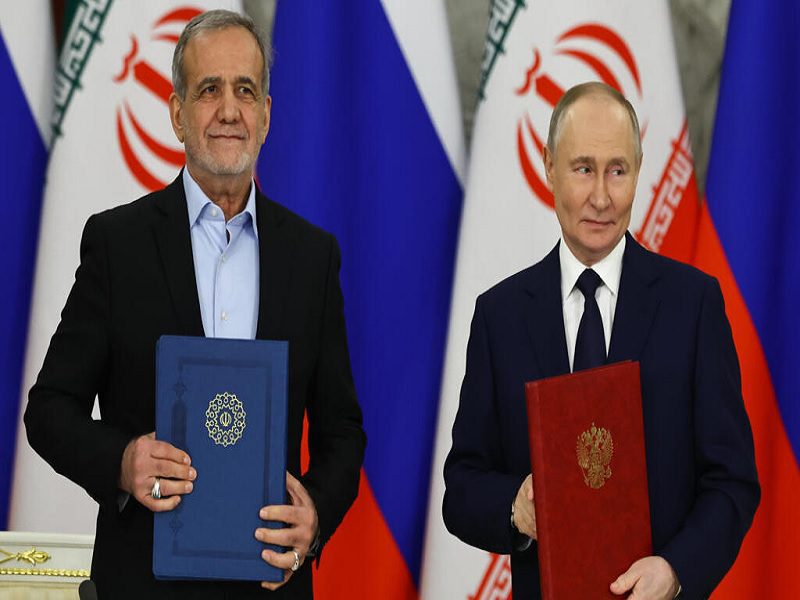
President of the Russian International Affairs Council Dmitriy Trenin reminded everyone in his recent piece asking “Can Russia Broker a New US-Iran Deal?” that “the Russians proposed a mutual military assistance clause to include in the (early 2025 strategic partnership) treaty, but the Iranians demurred.” After summer 2025’s 12-Day War, the ongoing Third Gulf War that’s stretched for nearly 10 months already, and Trump’s ominously implied threat to nuke Iran, that increasingly looks like a mistake.
Iranian Ambassador to Russia Kazem Jalali explained at the time that “The nature of this agreement is different. They (Belarus and North Korea) established partnership relations (with Moscow) in a number of areas that we did not particularly touch upon. Our country’s independence and security, as well as self-reliance, are extremely important. We are not interested in joining any bloc.” Putin later commented on the matter an in interview ahead of last year’s St. Petersburg International Economic Forum.
In his words, “we once proposed to our Iranian partners cooperation in air defence systems. At the time, our partners showed limited interest, and the matter concluded there.” This lends credence to Trenin’s claim that the Iranians rejected Russia’s proposal for a North Korean-like mutual military assistance pact. Russia almost certainly had no intent of risking World War III by directly attacking Israel and the US in Iran’s defense, however, so its motive was more than likely to create the basis for a grand deal instead.
While it can’t be known for sure, Russia probably envisaged the comprehensive modernization of the Iranian military with state-of-the-art equipment for future deterrence purposes in exchange for Iran transferring its highly enriched uranium to Russia per the latter’s longstanding proposal. Putin’s top aide Yury Ushakov confirmed that Putin referenced it yet again during his latest meeting with Steve Witkoff. The pretext that Israel and the US later exploited to attack Iran would have therefore disappeared.
In that event that they still attacked Iran at the cost of further discrediting themselves, then Russia would have likely only transferred such state-of-the-art military equipment and shared targeting intelligence with Iran, not directly attacked Israel and the US for sparking world War III over Iran. Nevertheless, the point is that this could have hypothetically deterred them from attacking Iran, but the likelihood of Russia once again offering a mutual military assistance pact to Iran in the future is likely nil.
That’s because doing so during ongoing hostilities would make Russia a direct participant therein, its aforementioned limited assistance that’s expected in that event would lend credence to the perception that Russia is an “unreliable ally”, and it doesn’t want to harm ties with the “Islamic NATO”. That US-backed bloc (all members are NATO members like Turkiye or “Major Non-NATO Allies” like Saudi Arabia and Pakistan) is considered to have formed in opposition to Iran, but Russia has no problems with them.
For these reasons, the most that Russia might do is agree to privileged military-technical and intelligence-sharing ties with Iran after the conflict ends, but likely conditional on Iran transferring its highly enriched uranium to Russia as part of a deal with the US. Such an arrangement could be agreed to during Putin’s expected meeting with Trump on the sidelines of the APEC Summit in China later this month. What Iran will likely never receive again, however, is an offer for a North Korean-like alliance.


