

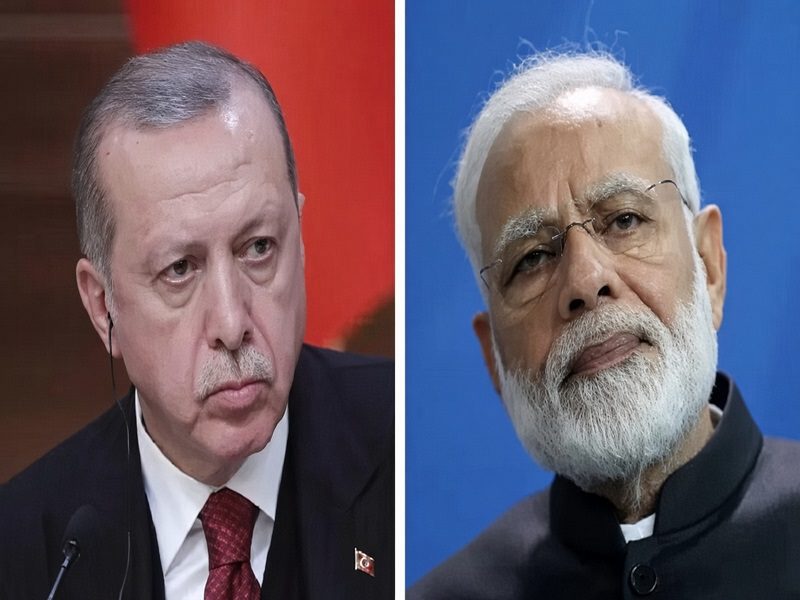
Turkish President Recep Tayyip Erdogan told reporters after early September’s SCO leaders’ summit that his country would consider full membership in the bloc. He clarified that this “never means turning its back on the West”, however, adding that “Türkiye is a country that can develop balanced relations with both the West and the East and deepen its ties accordingly.” For background, the SCO began as a bloc focused on thwarting the unconventional security threats of terrorism, separatism, and extremism.
It eventually expanded its responsibilities to include economic (including connectivity and financial) and political ones. China, Russia, Kazakhstan, Kyrgyzstan, Tajikistan, and Uzbekistan were its founding members, while India, Pakistan, Iran, and Belarus later joined as full members. Turkiye has been a dialogue partner since 2013. Full membership would enable it to vote on relevant issues as well as veto them, however token the SCO’s decisions are, thus imbuing it with more symbolic political influence.
Therein lies the problem for India, however, which has difficult ties with Turkiye. Turkiye is Pakistan’s decades-long military-technical partner, which has thus always led to Turkiye posing an indirect national security threat to India, and those two just clinched an alliance with each other and Saudi Arabia that many refer to as the Islamic NATO. During spring 2025’s Indo-Pak clashes, Turkiye extended full political support to Pakistan, and it also wholeheartedly backs Pakistan’s approach to the Kashmir Conflict.
India therefore has every reason to oppose Turkiye’s full membership in the SCO just like it has every reason to oppose Pakistan’s full membership in BRICS. Unlike Pakistan, whose hoped-for partnership with BRICS it can veto, India can’t put an end to Turkiye’s dialogue partnership with the SCO since it predates India’s full membership in the bloc. It must therefore accept that Turkiye will sit in on their meetings even though it has no power whatsoever to influence, let alone determine, their proceedings.
The unacceptability of Turkiye’s full SCO membership for India might cynically suit Russia’s interests too despite Putin maintaining friendly ties with Erdogan as shown by their meeting at the latest summit. These analyses here, here, and here detail the growing latent threat that Turkiye poses to Russia, which is connected to how August 2025’s “Trump Route for International Peace and Prosperity” (TRIPP) has the unstated dual purpose of a Turkish-led NATO military logistics corridor along Russia’s southern periphery.
TRIPP can also accelerate the transition of the Turkish-led “Organization of Turkic States” (OTS) between itself, Azerbaijan, Kazakhstan, Kyrgyzstan, and Uzbekistan (the last three of which are full SCO members) from a socio-economic group to a NATO-aligned militarized one. These processes are proceeding independently of Turkiye’s dialogue partnership with the SCO, but if they continue unfolding, then Turkiye could leverage them in the SCO if it became a full member to create an OTS sub-bloc therein.
Such a scenario would erode India’s and Russia’s influence in the SCO, which could be further reduced if Turkiye’s new Pakistani ally partners with its sub-bloc, thus creating a faction that would comprise nearly half of the SCO’s members at five out of eleven if Turkiye joins in full. India has no qualms about openly opposing Turkiye’s full membership due to their public disputes, which allows Russia to continue playing it cool with Turkiye in the SCO since only one veto is enough to end its dream of full membership.


