

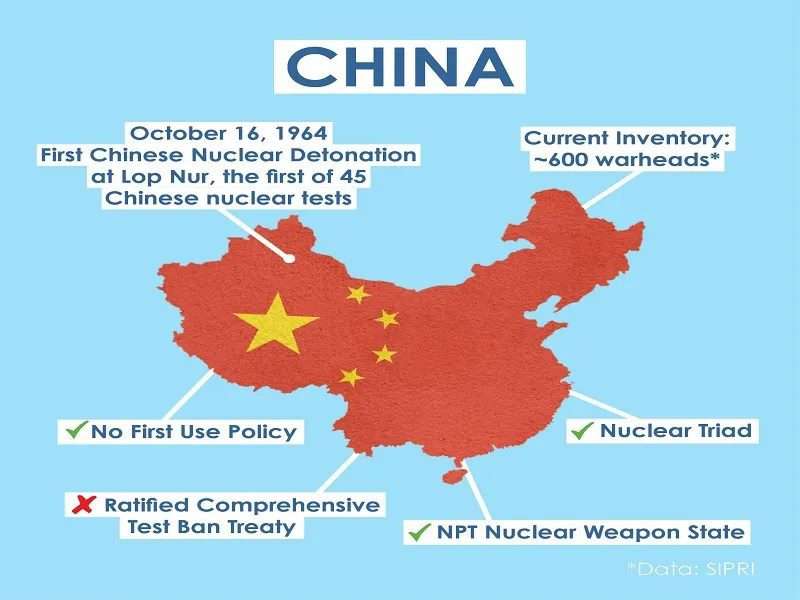
The White House’s fact sheet that was published after Xi’s visit to the US in September mentioned that “The President advocated for trilateral arms control negotiations between the United States, Russia, and China.” This is significant since Trump has long called for such talks, yet Xi reasonably remains reluctant to agree to them since China’s nuclear arsenal isn’t anywhere near as large as the US’ and Russia’s. Any arms control agreement would therefore freeze the gap between China and the US to the US’ benefit.
This subject was already analyzed in early February in a piece about how “Any New Strategic Arms Control Pact Between Russia & The US Hinges On China’s Participation”. It also cited the Department of War’s most recent annual report to Congress in December 2025 about China’s military-security developments over the past year to calculate that the Pentagon expects China to quintuple its nuclear stockpile from the low 200s in 2020 to over 1,000 by 2030. That works out to 80 new nukes a year.
The US and Russia each have over 5,000 nukes, however, so even that milestone would still leave China far behind them. Nevertheless, it can’t be ruled out that China might further scale its annual production of nukes to catch up to them sooner than if the current trend remains on track, which is later this century. The US fears China achieving nuclear parity, so it either wants China to agree to a trilateral arms control deal with Russia, or the US will inevitably resume its nuclear arms production.
The previously mentioned piece from the start of the year linked to an analysis in the introduction about the likelihood of a global nuclear arms race following Trump’s decision to let the US’ New START with Russia lapse despite Putin’s proposal to extend it for another year without preconditions. It was assessed that Russia’s reciprocal testing of nuclear weapons and/or resumption of nuclear arms production after the US first does so could lead to European, West Asian, and East Asian countries doing the same.
The relevance of referencing that assessment in this analysis about Trump “advocating for trilateral arms control negotiations between the United States, Russia, and China” during Xi’s visit is that he might have hinted to him that Japan and South Korea might go nuclear if the “big three” don’t reach a deal. That scenario could threaten China’s national security for self-evident reasons so Xi might reconsider his decision to eschew Trump’s proposed trilateral arms control talks before that becomes a fait accompli.
He also might not, however, for whatever his calculations may be. In that event, and if taken to its extreme, nuclear weapons might become the new status symbol of all middle powers over the next decade. Should that happen, then direct wars between new nuclear-armed states or proxy wars by one against the other a la NATO’s proxy war on Russia through Ukraine could become more frequent unless one of them restores deterrence per Foreign Affairs’ summertime assessment that was analyzed here.
With all this in mind, global strategic security is at a crossroads whereby a nuclear arms race will either begin with the likely participation of several middle powers or the “big three” will initiate arms control talks that’ll move them closer to a deal for averting the aforesaid worst-case scenario. It’s ultimately up to China which of these two futures will unfold, and thus, Xi must decide which of them is the lesser evil for his country. It seems like he prefers a nuclear arms race over freezing China’s gap with the US.


