


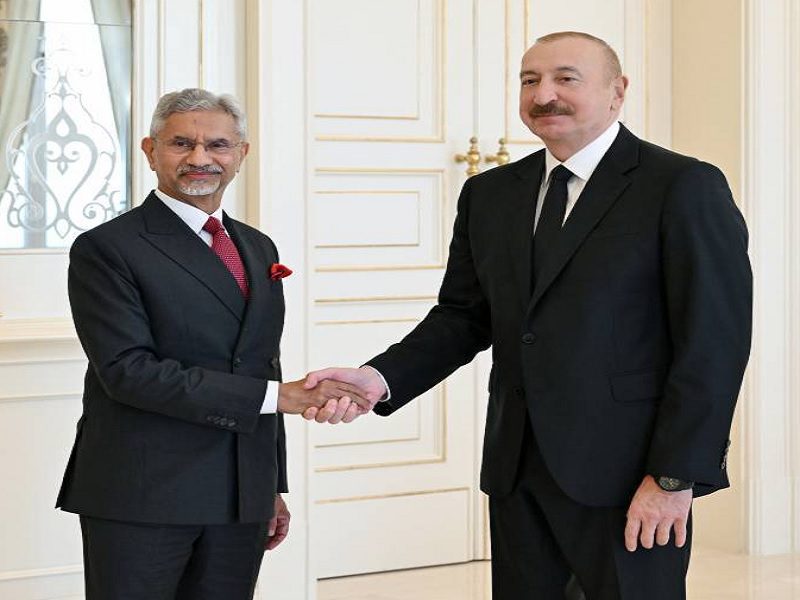
Indian External Affairs Minister (EAM) Dr. Subrahmanyam Jaishankar paid the first stand-alone visit of an EAM to Azerbaijan since his late predecessor’s in 2018. He met not only with his counterpart, but also with Azerbaijani President Ilham Aliyev, whose “positive sentiments” for the “shared endeavor” of “strengthening the relationship between the two countries” were “appreciated” by him after ties were earlier strained by the Karabakh and Kashmir Conflicts. Here are five takeaways from this historic visit:
———-
1. Azerbaijan Is Recalibrating Its Geostrategic Balancing Act
Jaishankar’s visit is taking place under the shadow of the newfound trouble in the Azeri-Turkish brotherhood sparked by Ankara’s alleged meddling amidst Baku’s de facto hijab ban in schools. As was suggested here, Aliyev appears to be relying on India as a regional counterbalance to avert Azerbaijan’s disproportionate dependence on Turkiye while reducing Iran’s threat perception of Azerbaijan due to its close ties with Israel. This speaks to his geostrategic wisdom as a nearly quarter-century-long statesman.
2. It’ll Also Likely Prioritize The “Central Asian Community”
This analysis here predicted that Azerbaijan will prioritize the “Central Asian Community” (CAC) over the Turkish-led “Organization of Turkic States” (OTS), and the nascent Azerbaijani-Indian rapprochement that was first proposed here in January 2024 suggests that he’s doing so. That’s because India is one of anchors of the North-South Transport Corridor (NSTC) along whose western branch sits Azerbaijan and its eastern one is Baku’s Central Asian allies. Their rapprochement can therefore be mutually profitable.
3. Azerbaijan & Iran Can Become Part Of The CASA Macroregion
“Russia Is Beginning To Conceptualize Central Asia & South Asia As The CASA Macroregion”, and the nascent Azerbaijani-Indian rapprochement coupled with a possibly forthcoming Azerbaijani-Iranian one driven by their shared NSTC interests can lead to Azerbaijan and Iran being conceptualized as part of CASA too. Azerbaijan is the CAC’s western economic gateway just like Iran is its southern one, so their connectivity roles vis-à-vis Central Asia are complementary, ergo their incorporation into this concept.
4. Jaishankar Likely Briefed Aliyev On Pakistan’s Threat To The CAC
Pakistan became one of Azerbaijan’s closest partners throughout the course of the 2020 Karabakh War, yet “Pakistan’s Latest Proxy War On Afghanistan Risks Destabilizing Central Asia”, thus threatening the CAC’s three out of six members which border Afghanistan. India knows a lot about Pakistan’s regional clandestine activity and is also close to the Taliban, which is the target of this regime change proxy war, so Jaishankar likely briefed Aliyev about this given Azerbaijan’s new membership in the CAC.
5. Aliyev Might Dissuade Erdogan From Getting Involved
Pakistan might exploit the Mecca Pact to request that Saudi Arabia finance the purchase of Turkish drones for use by Pakistan and/or its anti-Taliban proxies in Afghanistan, but President Recep Tayyip Erdogan could be convinced by Aliyev despite their problems not to get involved. That’s because Erdogan might prioritize the interests of Uzbekistan and Turkmenistan over Pakistan’s. After all, Erdogan is a Turkic nationalist, and Pakistan’s proxy war on Afghanistan threatens those two Turkic OTS allies.
———-
Putting it all together, Jaishankar’s historic visit to Azerbaijan is the latest development in the rapid sequence of moves that’s reshaping CASA’s geostrategic dynamics and that of its neighboring regions like the South Caucasus, which is occurring within the global systemic transition. Azerbaijan is quickly rising as a Middle Power, and with great power comes great responsibility, which contextualizes its mutually beneficial rapprochement with India. Their newly repaired partnership therefore has plenty of potential.