

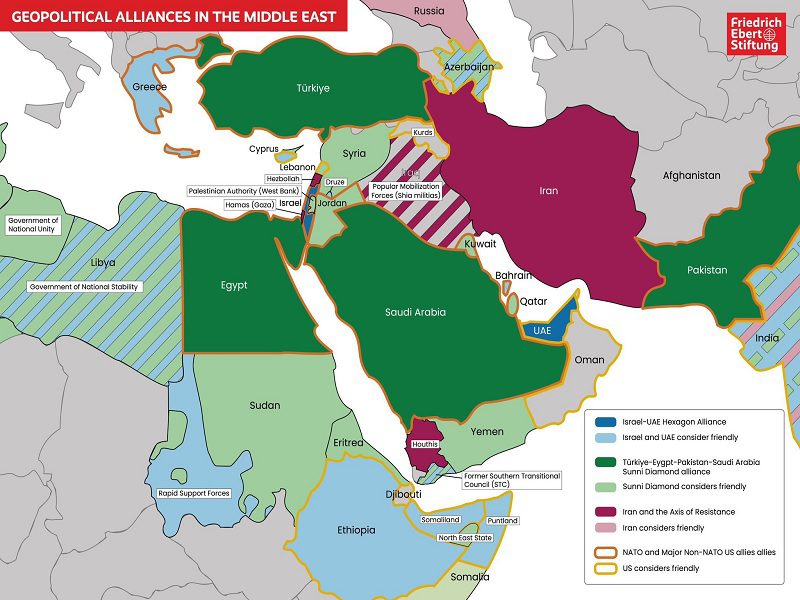
Netanyahu displayed a map of three regional alliances during a press conference over the weekend that’s since gone viral on social media due to its implications. The first alliance is the “Hexagon” between Israel and the UAE, the second is Iran’s Resistance Axis, and the third is the “Sunni Diamond” (also known as the Islamic NATO) in which Egypt is characterized as a member despite not having (yet?) formally joined. Five observations stand out the most and deserve some brief elaboration:
———-
1. Russia
Russia is designated as a country that Iran considers friendly but not one that the Sunni Diamond or Hexagon feels the same way about. That’s objectively inaccurate since the UAE is Russia’s top Arab trade partner, ties with Israel remain cordial despite Bibi’s recent criticism of Russia, and relations with the Sunni Diamond are generally fine (with the exception of the new Russian-Pakistani dispute over Taliban-led Afghanistan). This is therefore likely an electioneering ploy to win votes from anti-Russian Israelis.
2. Greece & Cyprus
Despite Netanyahu’s initial Hexagon declaration in late February mentioning Grece and Cyprus as part of this alliance, they’re only designated as countries that the Hexagon considers to be friendly. That’s a fair assessment, but it also suggests that whatever security talks they held behind the scenes since then to include those two as formal members of the alliance haven’t (yet?) borne fruit. Nevertheless, their formal membership in the Hexagon in the future shouldn’t be discounted either.
3. Iraqi Kurdistan
Interestingly, Iraqi Kurdistan isn’t designated as anything on Netanyahu’s map, therefore suggesting that it’s neutral. The reason why that’s worth drawing attention to is because it suggests Israel’s deep displeasure with their reported refusal to invade Iran, whether formally or clandestinely, during the Third Gulf War. Some speculate that a large part of Israeli-US war planning assumed that this would happen. Since it obviously didn’t, it makes sense why Israel doesn’t consider them to be friendly anymore.
4. Ethiopia
By contrast, Ethiopia is designated as friendly to the Hexagon, but it’s not multi-shaded like India is to designate that it’s also friendly with the Sunni Diamond (with the exception of Egypt) and the Resistance Axis. The reality is that Ethiopia has close ties with Turkiye, Saudi Arabia, and Iran, but Netanyahu might not have wanted to draw attention to this in order for casual Israeli observers to only consider it an ally. This suggests that there might be some serious security-related discussions going on behind the scenes.
5. Sudan’s RSF
The rebellious “Rapid Support Forces” are designated as friendly to the Hexagon, which lends credence to their long-suspected alliance with the UAE and reported talks with Israel over the last two years. Considering Sudan’s designation as friendly to the Sunni Diamond, which is veritably true due to its close ties with all four of its members, the Sudanese War can therefore be considered to be a proxy war between these two alliances even though it might not have begun as one.
———-
The importance of Netanyahu’s map is that it shows how Israel views the security alignment of countries in the broader region. Parts of it are inaccurate, however, but these inaccuracies are arguably driven by the political motives that were explained. Nevertheless, the top takeaways are that Israel considers Egypt to already be a de facto member of the Islamic NATO and the Sudanese War in which it’s heavily involved has become a proxy war between that bloc and the Hexagon, which could worsen bilateral tensions.