

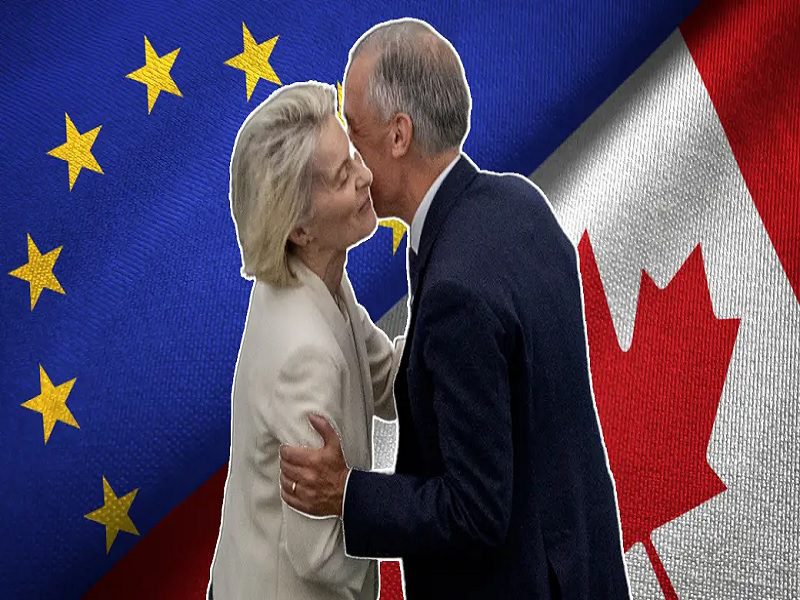
President of the European Commission Ursula von der Leyen invited Canada to become an “associate member” of the bloc, the relationship of which doesn’t presently exist, during her state of the union address. While it’s unclear what this entails due to its unprecedented nature, Trump preemptively warned that the US would impose “very heavy tariffs” on the EU if this move is “a hostile act” with “bad intentions”, perhaps alluding to the scenario of EU goods flooding the US market via Canada.
Russian officials have yet to react similarly, and perhaps they never will, but Canada was already expected to cooperate with the EU in the Arctic in ways that threaten Russia’s interests as was detailed in the analysis about why “The Arctic Front Of The ‘Cordon Sanitaire’ Is The Most Threatening To Russia”. Director of the Higher School of Economics’ Center for Interdisciplinary Arctic Studies Irina Strelnikova coincidentally published an analysis later that same day about how the EU plans to militarize the Arctic.
Canadian Prime Minister Mark Carney formally applied to join the UK-led Joint Expeditionary Force (JEF) around the same time, which includes the Nordic countries, the Baltic States, and the Netherlands. The first two categories of countries can collectively be described as comprising the Viking Bloc that’s expected to more actively contain Russia along the de facto merged Arctic-Baltic front of the “cordon sanitaire”. Canada’s membership in the JEF will therefore lead to more coordination with the Viking Bloc.
From the US’ grand strategic perspective, so long as the EU doesn’t exploit Canada as a backdoor into the US market, then its “associate membership” in the bloc isn’t a problem. In fact, closer Canadian-EU military-security coordination advances the US’ NATO 3.0 vision of allies taking on greater responsibilities in pursuit of shared interests, which in this case is containing Russia in the Arctic. The US’ Ambassador to NATO even recently declared that he wants them to take over Europe’s conventional defense.
Closer strategic coordination between Canada and the EU also embodies the concept of “Greater Europe” in the sense of the EU expanding its influence into another non-European country. Likewise, greater EU political influence over Canada probably won’t meaningfully challenge the US’ predominant influence there per se, but it could lead to a reprioritization of Trump 2.0’s “Fortress America” goals. This refers to the US’ envisaged restoration of hegemony over the Western Hemisphere.
If US influence over Canada is relatively weakened by its northern neighbor’s “associate membership” in the EU, albeit not in any way that erodes US hegemony over the Western Hemisphere, then Trump 2.0 might focus more fully on restoring the US’ traditional influence over Ibero-America. Depending on the form that this takes and how long it lasts, the US’ international self-identity might be reshaped in line with domestic demographic trends to take on more of an overall Hispanic identity than a European one.
Returning to the main topic after that brief tangent, Canada’s “associate membership” in the EU is therefore expected to cause trouble for Russia by worsening the threat that it’ll face in the Arctic, which will qualitatively change as those two synergize their containment efforts there. The Anglo-American Axis will continue to supervise this process, the first through the JEF and the second through its predominant influence over Canada, thus resulting in them remaining Russia’s principal geostrategic adversaries.


