


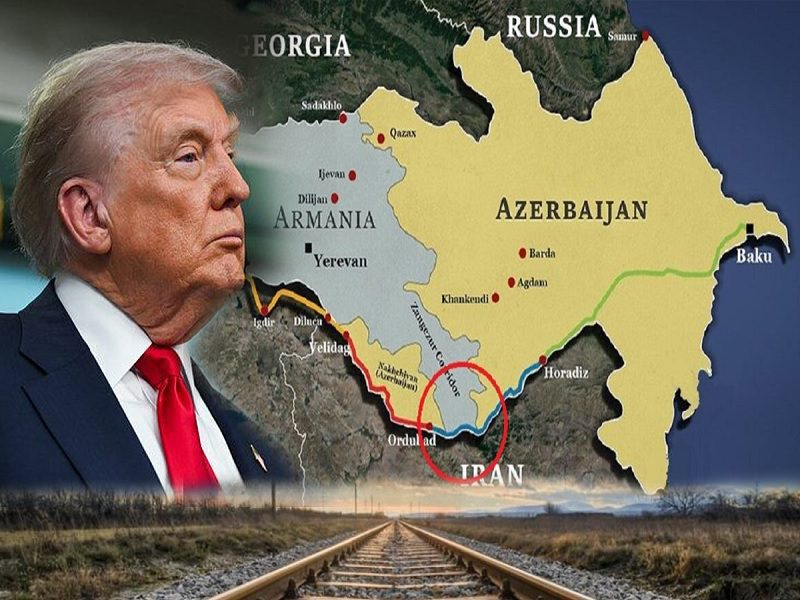
Iranian Foreign Ministry Spokesman Esmaeil Baghaei followed up on his country’s concerns about August 2025’s “Trump Route for International Peace and Prosperity” (TRIPP) through southern Armenia in early November. According to him, “We were given assurances that this project would in no way lead to changes in borders or geopolitics, that Armenian companies would carry out the construction and that no US military forces would be stationed there.”
For background, TRIPP is suspected of having the dual purpose of a Turkish-led NATO military logistics corridor along Russia’s southern periphery, which risks replicating a Ukrainian-like security dilemma that could be similarly disastrous for the South Caucasus involved. The recalibration of the Azeri-Turkish brotherhood throughout October, which was caused by Turkish criticism of Azerbaijan’s hijab ban in schools that was perceived as meddling, unexpectedly raised doubts about Baku’s commitment to this.
Even if Azerbaijan fine-tunes its geostrategic balancing act and prioritizes the “Central Asian Community” over the Turkish-led “Organization of Turkic States”, which would greatly reduce Russia’s threat perception of TRIPP, Russia and Iran would still require credible guarantees against TRIPP’s militarization. These could only come from Armenia, which will host TRIPP, and could include Russian or CSTO customs agents monitoring the shipments that’ll be sent between Turkiye and Azerbaijan along this route.
Neither Russia nor Iran wants TRIPP exploited as a Turkish-led NATO military logistics corridor along their respective southern and northern peripheries, but verbal reassurances from Armenia alone won’t suffice for them to believe it, especially given their dearth of trust in TRIPP’s 99-year-long US owner. Armenia’s ties with Russia have been strained since the last Karabakh Conflict in late 2020, and Yerevan has since suspended its membership in the Russian-led CSTO, but the bloc still officially deems it a member.
Therefore, provided that Armenia has the will (and perhaps with a gentle nudge from Azerbaijan amidst the fine-tuning of its geostrategic balancing act), a CSTO-led customs monitoring mission along TRIPP’s terminal points on Armenia’s borders with Turkiye and Azerbaijan could be a lasting solution. Russia would participate in the mission as part of the military bloc that it leads but the mission would be led by the bloc itself, not Russia per se, which might be more politically acceptable for Armenia.
Iran trusts Russia and knows that Russia wouldn’t turn a blind eye to TRIPP’s clandestine militarization since it too shares the same threat perception of this scenario. The US would also object to Iranian customs agents having anything to do with its corridor. While it might dislike CSTO ones playing a role in monitoring traffic along it, TRIPP was agreed to despite Armenia’s officially membership in the bloc, and Yerevan still has the sovereign right to rely on its partners for border security, customs monitoring, etc.
For these reasons, if Armenia is serious about neutralizing Russia’s and Iran’s threat perception of TRIPP, then it should agree to a CSTO-led customs monitoring mission for deployment along this corridor’s two terminal points in order to ensure that it’s not being clandestinely militarized by NATO. The details can be negotiated, but the importance is that Russia is able to keep an eye on the traffic along this route, otherwise it and Iran will continue to suspect that that they’re being encircled with all that could entail.