


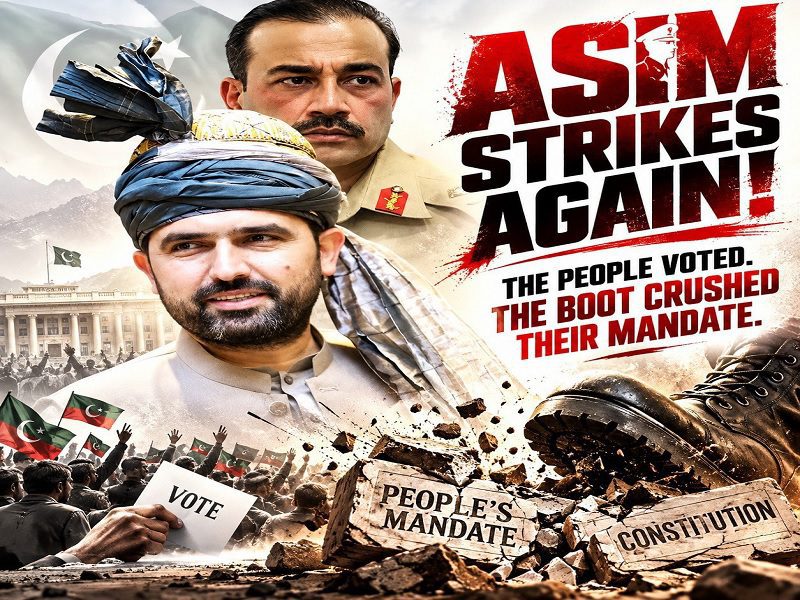
The central government carried out a coup in the Pakistani province of Khyber Pakhtunkhwa (KPK) through the imposition of emergency rule on misleading security-related pretexts and the abduction of its democratically elected opposition leadership led by Chief Minister Sohail Afridi. He represents the PTI party of politically persecuted former multipolar Prime Minister Imran Khan, who’s languishing in prison on trumped-up charges, and was leading a march on Islamabad to demand Khan’s release.
The state alleges that Afridi and his provincial leadership are “the B-team of the TTP”, the “Tehreek e Taliban Pakistan”, more popularly known abroad as the “Pakistani Taliban”. Their reasoning is that terrorism still plagues KPK, but the province has been afflicted by this scourge for the past two decades, so that’s nothing new. KPK also importantly borders Afghanistan, whose Taliban leadership that’s at war with Pakistan is sympathetic to the TTP’s cause, and its mountainous geography facilitates insurgency.
The state also strongly implied that Afridi and his provincial leadership are traitors who are more loyal to Taliban-led Afghanistan than to Pakistan due to their concerns about the collateral damage that another potential large-scale anti-terrorist operation in KPK could have for civilians. Prior such operations failed to eliminate terrorism as history proves, so these concerns are reasonable, not treasonous. In any case, they’ve been abducted by the state and KPK is now under central control, thus completing the coup.
The larger context concerns not only the previously mentioned Afghan-Pakistani War that’s been raging since February, but Pakistan’s rapid mission creep in the Yemeni War, which is widely perceived to be Chief of the Defense Forces Asim Munir’s vanity project. He replaced former Chief of Army Staff Qamar Javed Bajwa, who helped mastermind April 2022’s post-modern coup against Khan, as Pakistan’s de facto military dictator. Khan has referred to both as “small men in big offices” to mock their incompetence.
Munir’s coup in KPK simultaneously satisfies several objectives. First, it further centralizes his power over the country by removing the opposition-led provincial government in Pakistan. Second, he could now more easily advance his reported plot to radically divide Pakistan’s four provinces into anywhere from a dozen to over 100 as part of a typical divide-and-rule strategy. Third, the de facto state of martial law that’s now imposed upon KPK could be expanded across the country on similar security-related pretexts.
To elaborate on the last point, the TTP in KPK and the “Balochistan Liberation Army” (BLA) in Balochistan are serious problems for the state, the Afghan-Pakistani War is still raging with no end in sight, and direct involvement in Yemen could prompt sectarian killings against Pakistan’s large Shiite minority. Munir’s coup in KPK could therefore be a trial run for formalizing his de facto military dictatorship on these security-related pretexts in the coming future.
In his pursuit of power, however, Munir risks replicating what Pakistanis widely consider to be the East Pakistan tragedy whereby one of his predecessor’s similar pursuits led to the loss of today’s Bangladesh. Khan and Afridi have both warned about this since they, as truly patriotic Pakistanis, fear that Munir might unleash ultimately uncontrollable processes that further “Balkanize” their ethno-regionally diverse nation. Pakistan is at the precipice of such a disaster precisely because of this “small man in a big office”.