

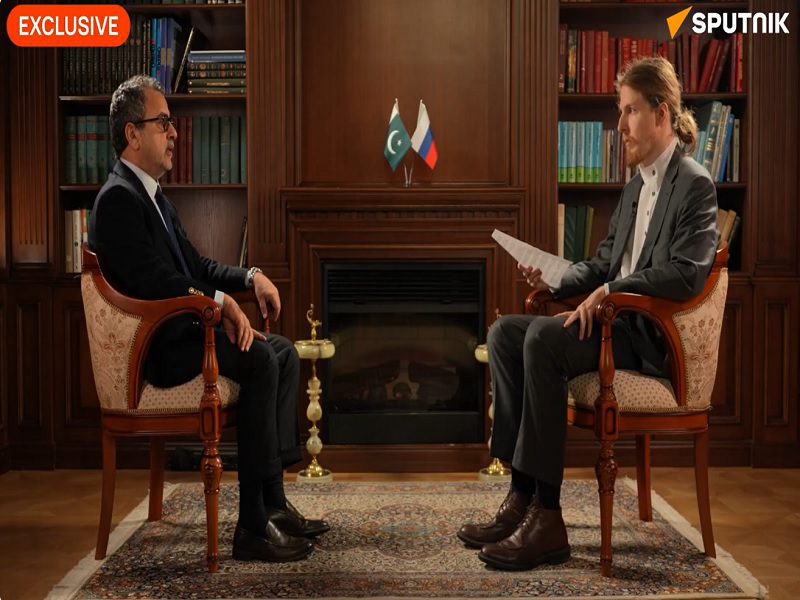
Head of Sputnik International Dimitri Simes Jr. recently interviewed Pakistani Energy Minister Sardar Awais Ahmad Khan Leghari, who also co-chairs the Pakistan-Russia Intergovernmental Commission. Leghari began by reaffirming Prime Minister Shehbaz Sharif’s policy of considering Russia a priority partner for Pakistan but lamented their low level of bilateral trade at less than $400 million. He then suggested that more connectivity between them is required to unleash their full economic potential.
Simes Jr.’s next question about the Indus Waters Treaty that India suspended in response to Pakistan’s link to the 2025 Pahalgam terrorist attack prompted Leghari to accuse India of “terrorism” with no pushback from Simes Jr. despite India officially being Russia’s “special and privileged” strategic partner. The conversation then shifted to Leghari inviting Russia to participate in hydropower projects and repeating his government’s proposal for it to revive the Soviet-built Pakistan Steel Mills project.
The next part saw Simes Jr. ask Leghari about Pakistan’s participation in the North-South Transport Corridor between Russia and India via Iran, to which Leghari described it as a promising means for scaling bilateral trade. It’s been functionally suspended due to the Third Gulf War, however, and the same goes for the similarly promising trans-Afghan railway proposal due to bilateral hostilities. The latter also makes moot Simes Jr.’s subsequent question about the proposed Minsk-Moscow-Karachi railway.
The interview then concluded with Leghari hailing Sputnik’s role in improving people-to-people ties and expressing hope that more events will be organized to bring their people together. Reflecting on his interview, he conspicuously didn’t confirm any deals for improving bilateral trade, and the two overland connectivity routes that could facilitate this are functionally suspended. The only newsworthy aspect is that he accused India of “terrorism” on one of Russia’s flagship media outlets without any pushback.
The reason why Leghari’s interview was bereft of any substance is arguably due to the influence that Pakistan’s US patron has exerted over its policies since April 2022’s post-modern coup against former multipolar Prime Minister Imran Khan, who now languishes in jail on trumped-up politicized charges. Pakistan’s Finance Minister also declared what amounts to a pro-US financial pivot last month, thus reducing the likelihood that Pakistan would choose Russian companies over US ones for big-ticket deals.
The obviousness of the aforesaid observation might also be why Simes Jr. conspicuously didn’t ask Leghari about the prospects of their countries clinching the major oil deal that’s been discussed since 2022 despite Leghari being the Energy Minister who’d know more about this subject than anyone else. The interview was clearly structured in a way that promotes the importance of big-ticket Pakistani-Russian deals without addressing the elephant in the room of the US’ de facto veto power over them.
Be that as it may, and regardless of whether Leghari was misleading Simes Jr. about his government’s sincerity in clinching big-ticket deals with Russia, it’s still overall a positive development that he spoke highly about relations with Russia. At the very least, his interview therefore serves to improve each side’s perceptions of the other among those who watched it or at least read about it, and hopefully one day Pakistan will bravely defy the US to reach its long-discussed major energy deal with Russia.