

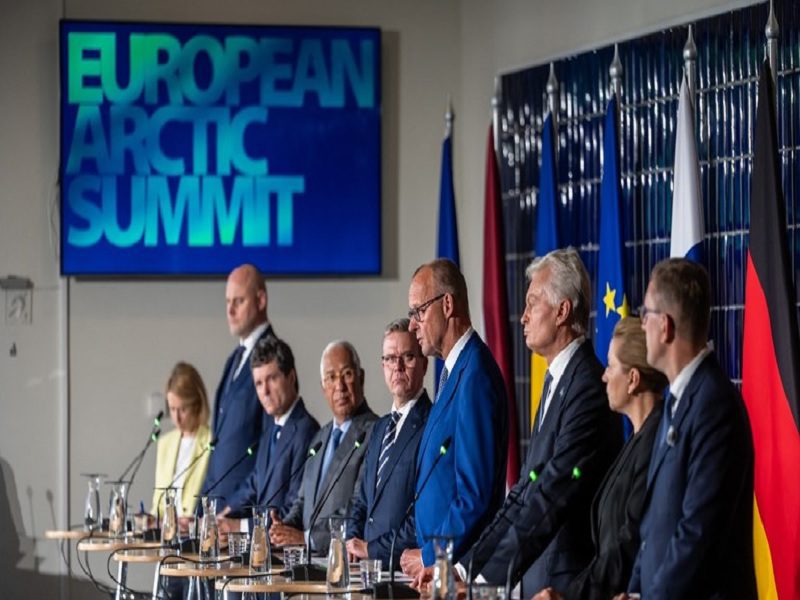
Director of the Higher School of Economics’ Center for Interdisciplinary Arctic Studies Irina Strelnikova shared an important observation about mid-September’s inaugural European Arctic Summit. According to her, “The countries represented there effectively form a single line stretching from the Baltic to the Black Sea. They no longer view the Arctic in isolation. Instead, they are beginning…to link Arctic issues with the Baltic and Black Sea regions. This, in my view, is a genuinely worrying signal.”
It was warned earlier this year that “The Arctic & Baltic Fronts Of The NATO-Russian New Cold War Are Dangerously Merging”, with the resultant (likely Swedish-led) Viking Bloc forming the northwestern flank of the new “cordon sanitaire” that Trump 2.0 assembled around Russia over the past year. The other flanks are the one that Germany and Poland are competing to lead in Central Europe, the Turkish-led one along Russia’s entire southern periphery, and the Japanese-led flank in Northeast Asia.
More recently, it was assessed that “The Arctic Front Of The ‘Cordon Sanitaire’ Is The Most Threatening To Russia”, namely because the US’ Golden Dome megaproject greatly mitigates Russia’s nuclear second-strike capabilities while the Viking Bloc’s rapid military build-up dwarfs Russia’s regional assets. This analytical background lends credence to Strelnikova’s implied warning that three of the New Cold War’s fronts – the Arctic, Baltic, and Black Sea ones – are merging into a single one against Russia.
What’s so significant about her observation, which was importantly shared with RT and published on their front page at the time, is that it represents growing awareness of the latest trend in the evolving European security architecture west of the new “Iron Curtain”. Deputy Chair of the Security Council Dmitry Medvedev already drew attention to the threat posed by Germany’s remilitarization, but this is the first known time that attention was drawn to the “cordon sanitaire” by anyone of influence in Russia.
Although Strelnikova didn’t use that word, she nevertheless acknowledged the growing coordination between the Arctic, Baltic, and Black Sea fronts of the New Cold War, which can collectively be described as the western front of the “cordon sanitaire”. Its assemblage over the past year embodies the US’ NATO 3.0 concept of the EU playing a greater role in containing Russia. This trend also defies Russia’s envisaged European security architecture as described in its security guarantee requests from late 2021.
For as much as Russian policymakers might sincerely believe that the military-security developments west of the new “Iron Curtain” over the past nearly half-decade can be reversed through a political settlement of the Ukrainian Conflict, that’s arguably not going to happen, which they should recognize. Failing to at least countenance this scenario could lead to the formulation of policies that inadequately advance Russia’s objective military-security interests or might even inadvertently worsen them.
Strelnikova’s tacit recognition of this reality is therefore an important step towards more Russian experts incorporating this state of affairs into their work, which can in turn assist with policy formulation. Continuing to indulge in wishful thinking, which Putin cautioned his country’s strategic forecasters against in summer 2022, won’t change the situation and might even make it worse. The sooner that Russian experts realize what their country is up against, the sooner that they can help it rise to the challenge.