

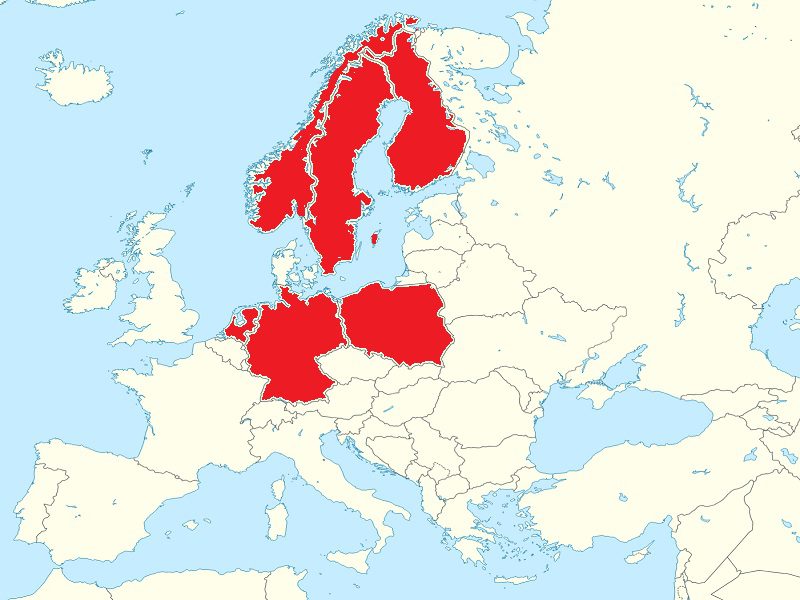
Politico recently reported that “Pentagon excludes key allies from NATO meeting” in Poland later this month that’ll also see the participation of Norway, Sweden, Finland, the Netherlands, and Germany. The first three comprise what’s been described as the Viking Bloc while the last two and Poland pioneered the “military Schengen” in early 2024 for optimizing NATO’s east-west military logistics. The upcoming meeting in Poland will be the third time that the “Bergen Group”, as it’s been called, has met since June.
Politico’s report drew attention to the exclusion of France, the UK, and the Baltic States, the first two of which are nuclear powers while the last three border Russia. There are understandable reasons why they weren’t invited to participate in the Bergen Group. Trump 2.0’s National Security Strategy snubs Western Europe due to its radical demographic changes that the US believes risk its countries’ future military-political reliability while the Baltic States are infamous for their irrational behavior towards Russia.
The gist of NATO 3.0 is that the US’ reliable and rational allies will contain Russia in Europe while the US “Pivots (back) to (East) Asia” for more robustly containing China. France and the UK can’t be relied upon as explained while the US fears that the irrational Baltic States could provoke a war with Russia. The US will therefore depend on the Viking Bloc to contain Russia in the Arctic-Baltic region, Germany and Poland to contain it in Central Europe, and the Netherlands to facilitate trans-Atlantic military logistics.
Under Secretary of War for Policy Elbridge Colby, who’s the mastermind behind NATO 3.0, explained the purpose of the Bergen Group in late September when updating the Senate Armed Forces Committee on the implementation of the National Defense Strategy. He told them at the time that “We are also engaging high-performing allies in small-group settings, such as the selective Bergen Group format, thereby accelerating efforts to build coalitions and drive progress toward NATO 3.0.”
Colby’s reference to “building coalitions” can be understood as the US-led interplay between the three main actors on the western flank of the new “cordon sanitaire” that Trump 2.0 assembled around Russia. While the Viking Bloc’s role and geographic scope thereof are clear, the same can’t be said for Poland’s and Germany’s, which are in a “friendly competition” to lead Russia’s containment in Central Europe. The outcome of this rivalry, which the US is capable of influencing, will reshape continental geostrategy.
There’ll either be a German–dominated militarized EU in which Poland is subordinated to Germany or a militarized EU in which the US-backed Polish-led Intermarium counterbalances German hegemony while complementing its efforts to contain Russia. The US’ interest in obtaining a permanent military base in Poland, the bill of which would be footed by Warsaw, suggests that it prefers the second scenario. All will become clearer, however, after the impending end of the Pentagon’s European force posture review.
Regardless of the outcome of the German-Polish “friendly competition” to lead Russia’s containment in Central Europe, those two, their Dutch “military Schengen” partner whose ports play an irreplaceable role in trans-Atlantic military logistics, and the Viking Bloc are the US’ top European allies. All six are considered reliable and rational, ergo their inclusion in the Bergen Group, which is Colby’s preferred “small-group setting” for “driving progress toward NATO 3.0’s” European-led containment of Russia.


