

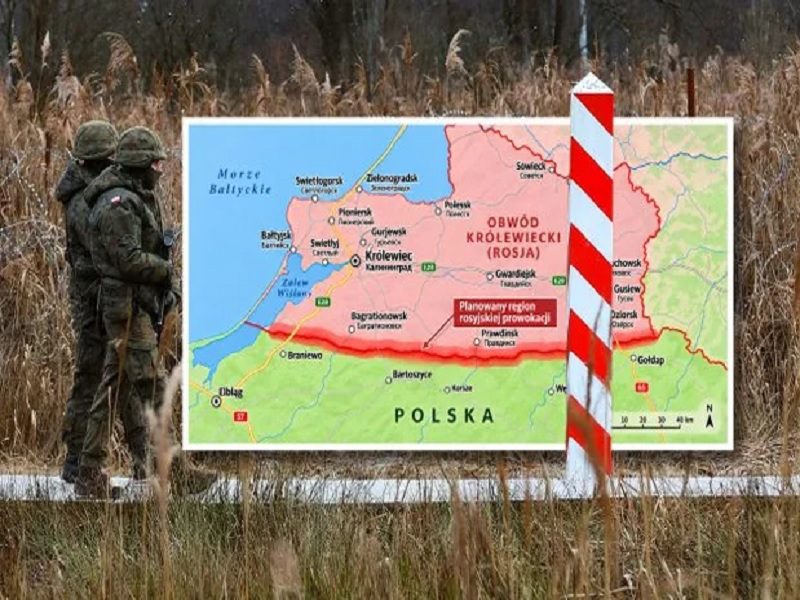
Poland’s conservative newspaper Rzeczpospolita cited unnamed members of the security services to report that Russia was planning a Gleiwitz-like false flag provocation, which refers to the Nazis’ infamous one that was exploited as the pretext for invading Poland, in Kaliningrad. According to them, it was to be blamed on Ukraine, some of whose nationals in Poland would be recruited to infiltrate the border as part of the terrorist attack that the Kremlin was allegedly orchestrating against its own citizens in that exclave.
The unannounced police and counter-terrorism operation that Poland recently carried out on the border is credited by Rzeczpospolita with deterring this provocation, the purpose of which was to widen the divide between Poland and Ukraine with a view towards rupturing their relations. For as compelling as their narrative might seem to some readers, it’s difficult to believe that Putin authorized a false flag operation that would have killed his own people, let alone in Kaliningrad of all places.
Polish Foreign Minister Radek Sikorski’s boast in mid-September that NATO would swiftly defeat Russia in the scenario of a hot war between them prompted Russian officials to remind the bloc that their country would resort to nuclear weapons if Kaliningrad were invaded. Putin soon thereafter reaffirmed this policy on the grounds of the power asymmetry between them. He’s the consummate pragmatist and has repeatedly eschewed retaliatory escalations against NATO and Ukraine in order to avoid World War III.
So reluctant has he been to escalate even after Ukraine’s NATO-facilitated “Operation Spiderweb” against Russia’s nuclear triad in summer 2025 that the West no longer believes that he has the will to deter them by enforcing his country’s red lines. This contextualizes why France defied Russia’s repeated threats to target foreign forces in Ukraine by deploying some of its own there since earlier this summer. Importantly, no official Russian, French, or Ukrainian sources indicate that they were attacked even once.
In fact, Foreign Minister Sergey Lavrov revealed when asked about this that “We have conveyed our concern through the available channels”, that’s it. Quite clearly, Putin has no intention to escalate tensions with NATO, so it’s unbelievable that he authorized a false flag operation for that purpose. It’s all the more fanciful that the aforesaid supposedly targeted Kaliningrad given how afraid Russia is of NATO invading its exclave that it publicly threatened to use nukes in that event in a bid to deter the bloc.
Assuming that Poland truly obtained intelligence indicating that some Ukrainians planned to infiltrate Kaliningrad, then Occam’s razor suggests that the simplest explanation of this being a Ukrainian provocation is the most likely. Kiev is widely considered to have countless agents among its approximately one million nationals in Poland, is assessed as having an interest in escalating NATO-Russian tensions, and has been previously accused by Moscow of plotting false flags to this end.
This one would have caused a kinetic cross-border incident if Russian border guards fired into Poland to stop the Ukrainian infiltrators, which could have sparked a NATO-Russian crisis that Zelensky might have expected would derail the newly revived peace process. It was with the intent of preemptively averting such a scenario that the Russian International Affairs Council called for the creation of a crisis-control channel between Russia, Poland, and the US last month. That’s now more urgent of a need than ever.


