

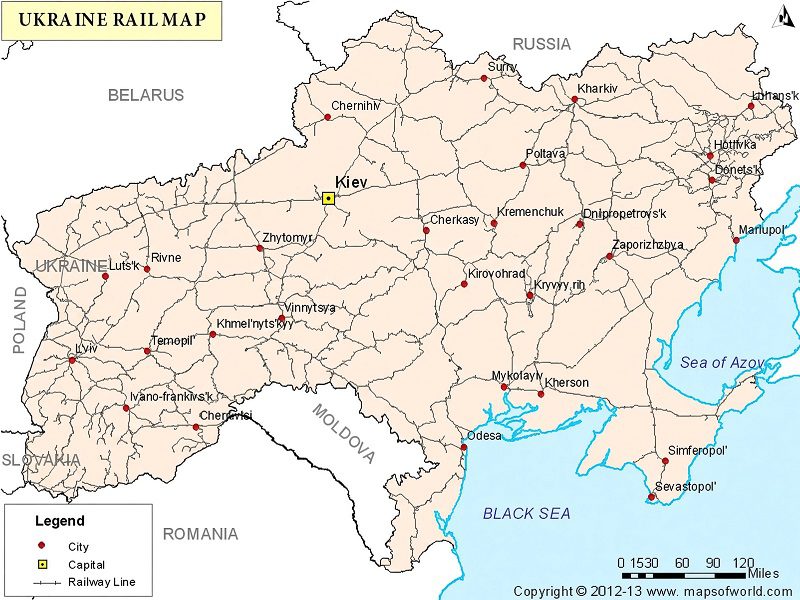
Politico published a piece in mid-September about how “Russia hunts Ukraine’s trains”. Global attention was first drawn to Russia’s precision strikes against this element of Ukraine’s military logistics less than a week prior after Russia hit a locomotive on Ukraine’s border with Poland for the first time ever. Former British Prime Minister Boris Johnson had just passed through while former CIA chief David Petraeus was still at the station, which prompted the Western media to speculate that it was an assassination attempt.
Circling back to Politico’s article, they reported that “Moscow’s strikes have damaged or destroyed more than 500 locomotives since the full-scale invasion began in 2022; more than 60% of them have been hit in the past eight months. Ukrainian Railways is now losing 37 to 40 locomotives a month.” They also quoted the chairman of Ukraine’s state railway operator who told them that “the pace of destruction is so fast that our financial resources (for carrying out repairs) are insufficient.”
Another important point that Politico shared with their audience is that “[Ukraine’s state railway operator] uses a 1,520-millimeter track gauge, rather than the 1,435-millimeter standard used across most of Europe, limiting the pool of rolling stock that partners can quickly transfer. Only the Baltic states and Finland use similar equipment. Lithuania has pledged to send locomotives to Ukraine as part of its winter support package.” This greatly limits the number of replacements and spares for Ukraine.
As was assessed here after Russia’s first-ever locomotive strike on Ukraine’s border with Poland, “Russia can now carry out precision strikes anywhere in Ukraine at any time of its choosing. So long as Russia has enough munitions…then it could be sustained indefinitely for coercing significant unilateral concessions from Ukraine by the expected resumption of trilateral talks with the US next month. Putin’s escalation might also be aimed at preempting Zelensky’s threatened closure of Russian airspace.”
The new “war of attrition” that the US (and also interestingly France) helped Ukraine wage against Russia over the summer as part of Zelensky’s ultimately failed 40-day influence operation aimed at coercing Putin into a ceasefire drastically backfired by provoking Putin to mildly “escalate to de-escalate” in kind. This has since taken the form of precision strikes against gas stations, ports, now locomotives, all of which threatens to cripple Ukraine’s military logistics to cut off the flow of NATO equipment to the front.
Putin therefore judo-flipped Zelensky by waging his own “war of attrition” against Ukraine in response to Zelensky’s, and Europe’s latest war hysteria is likely a reaction to its leaders realizing that Russia might inflict game-changing damage to Ukraine by the end of the winter. European NATO can accordingly either escalate even more to the point of intercepting Russian projectiles over Ukraine and/or deploying a limited number of troops there at the risk of World War III or accept Ukraine’s potentially swift defeat.
It’s therefore not hyperbole to predict that systematic Russian strikes against Ukraine’s locomotives all throughout the coming winter, if paired with equally systematic strikes against its gas stations, ports, power plants, and other infrastructure, could revolutionize the conflict’s dynamics. Instead of another forever war like European NATO is preparing for, the conflict might end with a decisive Russian victory by next spring if this precision strike campaign leads to a breakthrough along the front.


