

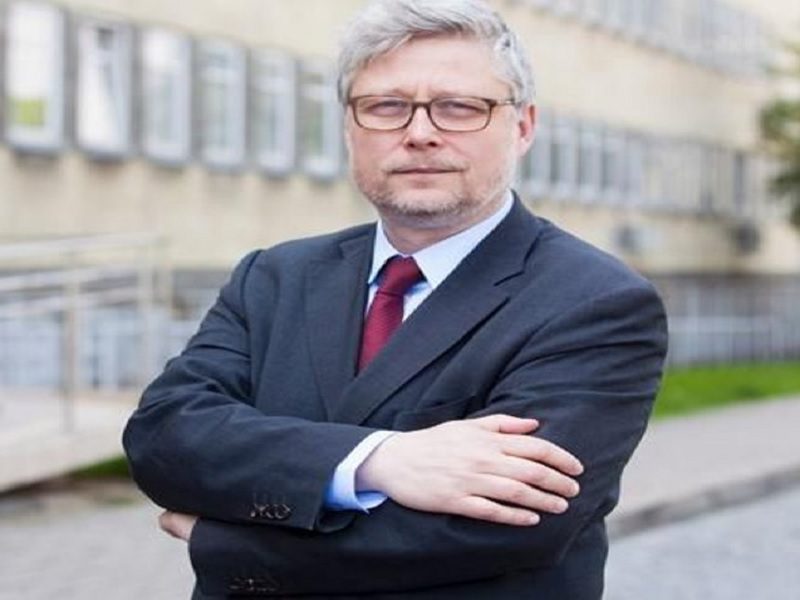
Polish journalist Marek Cichocki shared an interesting reaction to Russian Foreign Minister Sergey Lavrov’s recent meeting with his German counterpart, the first in four years, in an article for leading conservative outlet Rzeczpospolita. The last part of his brief piece saw him advise that “Preventing Berlin from returning to its former policy with Russia is our primary task, in which Ukraine constitutes a crucial argument”, after which he warned that “Russia will do everything to regain its key European ally.”
For background, Polish conservative-nationalist discourse on Russia centers on the fear that it and Germany might clinch a new Molotov-Ribbentrop Pact for re-dividing Central & Eastern Europe into spheres of influence between them. Nord Stream was accordingly conceptualized by them as embodying this plot by giving Germany an economic incentive to agree to such a deal with Russia. It’s therefore unsurprising that Cichocki described Poland’s “primary task” as keeping them apart in the post-war era.
Poland’s options for doing so are limited, however, especially in light of the possibility that the US might purchase Nord Stream as part of a grand deal with Russia for controlling the post-war resumption of its energy exports to Germany. Be that as it may, Lavrov recently channeled Polish conservative-nationalist discourse about Germany by warning that “we are witnessing attempts to create the Fourth Reich”, which also alludes to Russia’s new threat perception of Germany as a result of its rapid remilitarization.
Regardless of whatever might happen, the most effective way for Poland to manage its own threat perception of Russia is by leading the Intermarium and expanding its “snowdrop diplomacy” with Belarus into a rapprochement with Russia, which the US could help Poland with. Readers can learn more about this here and here, but in brief, the gist is solidifying Poland’s central role along the “cordon sanitaire’s” western flank and then leveraging mutual de-escalation moves for mutual economic benefit.
It’s also likely that the US would support this proposal for three main reasons. First, it too fears the geostrategic consequences of a potential post-war Russian-German rapprochement, which could reduce the US’ newly hegemonic influence over the EU with all that might entail. Accordingly, the US might consider Poland to be a much more reliable ally for leading NATO 3.0’s post-war containment of Russia, which the US plans to offload to Europe as it “Pivots to Asia” for more robustly containing China.
Second, the US doesn’t want an EU-Russian war erupting like could happen if Germany dominates a militarized EU, ergo its potential interest in a US-backed Polish-led Intermarium gently counterbalancing Germany and entering into a rapprochement with Russia for optimally managing post-war tensions. And finally, the US’ explicitly described Polish “model ally” might then became the gatekeeper of overland EU-Chinese trade if this is scaled via Belarus-Russia, which could be leveraged by the US if ever needed.
No realistic alternative to the proposal shared in this piece has thus far been shared by a public figure of Cichocki’s caliber for how Poland could best manage post-war Russian-German relations. The only viable way is by establishing leadership over the Intermarium and leveraging mutual de-escalation moves with Russia for mutual economic benefit. Simply put, Poland must become a much more important partner for Russia than Germany, and this can realistically be achieved via the aforesaid means if the will exists.
This analysis was originally published at the Russian International Affairs Council.


