

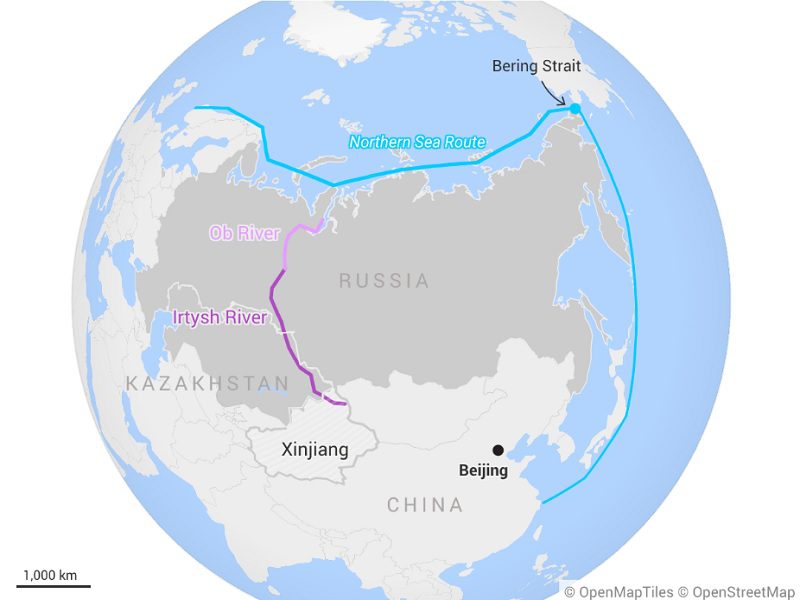
The South China Morning Post published an intriguing piece in late August about how China could use the Irtysh-Ob river system to connect to the Arctic Ocean via Xinjiang, Kazakhstan, and Russia. Although they noted that “The Chinese government has not made any statement on the proposed route”, the experts that they interviewed emphasized its attractiveness since it evades the Bering Strait, Bab el Mandeb, and Suez Canal chokepoints upon which Sino-EU maritime trade is dependent.
At the same time, however, “Navigating the river system would mean overcoming the harsh Siberian winters that freeze the waterway for up to six months a year, possibly limiting commercial shipping to a narrow summer window. Meanwhile, seasonal low water levels and heavy silting also create shifting sandbars, which would require huge dredging capacity so that large cargo barges would not run aground.” One of the experts also predicted that billions of dollars of investment would be required.
Be that as it may, The High North News published a piece in early 2019 about how “Kazakhstan Looks To the Arctic For a New Trade Route”, which importantly drew attention to how South Korea of all countries proved the feasibility of this corridor several years prior. In 2016, “two large petrochemical reactors, each weighing in at over 500 tons, were delivered from South Korea via the Northern Sea Route and along 2,000 kilometers of the Ob’-Irtysh to Pavlodar.” Upriver dams make further navigation impossible.
With this insight in mind, China might export agricultural, industrial, and textile products from Xinjiang to Kazakhstan’s Pavlodar by rail before shipping them down the Irtysh-Ob river system to the Arctic en route to Europe. If it’s economical enough, then exports from elsewhere in China could be sent along this route too, but it’s unlikely to become a major trade corridor due to the ease of relying on the Northern Sea Route (NSR) in full or the Middle Corridor (MC) across the Eurasian Heartland.
While the US could hypothetically try to blockade the Bering Strait, that would indisputably risk a hot war with Russia, so it’s much more likely to only monitor shipments across this route while possibly developing the Northwest Passage through Canada’s Arctic archipelago to compete with the NSR. As for the MC, August 2025’s “Trump Route for International Peace and Prosperity” (TRIPP) through southern Armenia will optimize it, thus making it even more attractive of a corridor to the EU than it already is.
Unless Russia and the US clinch their hoped-for resource-centric strategic partnership, the US is expected to oppose Sino-EU trade via Russia in any capacity apart from traversing its Arctic waters, so it might coerce the EU into rejecting imports from along this route (perhaps even sanctioning it). Even though Kazakhstan is their partner, they’d prefer for its trade with them to be conducted via the TRIPP-facilitated MC, not across Russia. These political factors further reduce interest in the Irtysh-Ob route.
That being the case, the Irtysh-Ob route isn’t a viable Eurasian trade corridor to the Arctic, including for China. The economic and political costs are much too high, at least for the time being, to make this profitable. If there’s a Russian-US breakthrough that leads to at least partial sanctions relief, however, then the US might encourage its closest Asian partners like South Korea to trade with Kazakhstan (and Russia) through these means while still pressuring the EU not to accept Chinese exports from this route.


