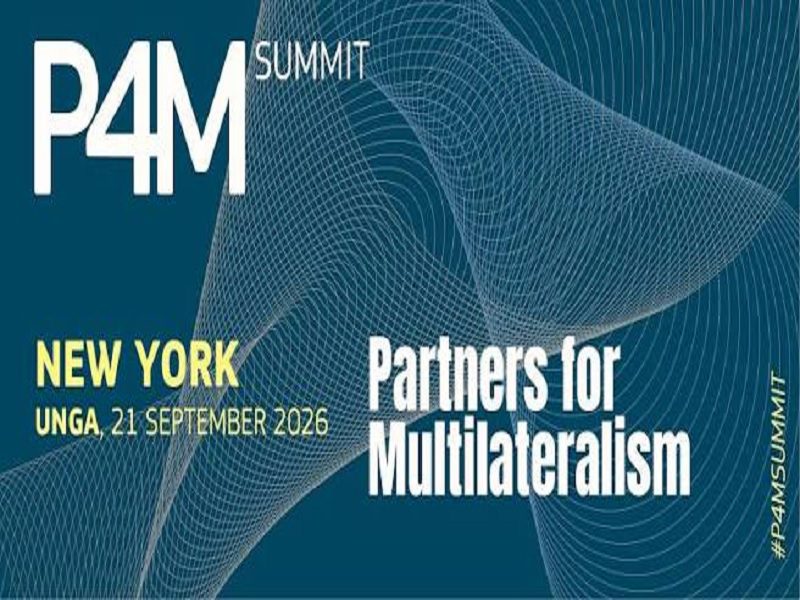
RT drew attention to Indian External Affairs Minister Dr. Subrahmanyam Jaishankar’s remarks at the inaugural Partners for Multilateralism, International Law, Peace and Prosperity (P4M) Summit on the sidelines of the UNGA in late September. The gist is that multilateralism is being challenged like never before by “extreme competition, geopolitical tensions and actual conflicts”, which has contributed to “The 4F crisis of Fuel, Food, Fertilizer and Finance” that he argues can only be addressed multilaterally.
The P4M’s joint statement echoes these concerns and was initially co-sponsored by Australia, Barbados, Brazil, Canada, the European Union, India, and Kenya with signatories from over a dozen countries like Turkiye as well as separate EU members such as Slovakia. Russian geo-economic guru Yaroslav Lissovolik, who runs BRICS+ Analytics, noted in his article about this group that it could “build linkages across the North-South axis between the middle powers from the developed world and the Global South.”
He expects that “the ranks of the P4M platform could well expand via the middle powers in Asia, most notably such ASEAN economies as Vietnam, Malaysia and/or Indonesia”, which are either formal BRICS members like Indonesia or BRICS+ partners like Vietnam and Malaysia. The P4M also embodies India’s long-running multi-alignment strategy and France’s newfound call for a “coalition of independents”. Here are three background briefings that concisely document recent ideational developments of relevance:
* 2 March: “India’s New Multi-Alignment Trend Prioritizes Middle Powers For Tri-Multipolarity Purposes”
* 23 April: “Macron Is Taking A Page From Modi’s Tri-Multipolarity Playbook”
* 11 September: “Korybko To Bordachev: Multi-Alignment Is The New Non-Alignment”
In practical terms per their joint statement, the P4M supports “diversified and resilient global supply chains, reform of the multilateral trading system, an improved international financial architecture and stronger coordination on international finance, digital transformation, artificial intelligence, climate change and global health issues.” The significance of these goals is that they tie Brazil, India, and Turkiye more closely to the EU at this crucial moment in the global systemic transition.
While the EU has already subordinated itself to the US as a result of the latter’s hegemonic power play over the Global West after the start of the Ukrainian Conflict’s large-scale phase in early 2022, this doesn’t automatically mean that those three will bandwagon as the US’ other junior partners. Rather, while all three retain close ties to the US that even continue growing in some respects despite friction under Trump 2.0, they’re expected to rely on the EU to help advance their aforesaid shared interests.
This could take the form of closer coordination on these issues through P4M formats in the future and voting as a bloc on them at the UN for whatever that global body’s non-binding resolutions are worth. On the geostrategic front, Brazil wants to reduce its dependence on the US, India wants to position itself as a more reliable center of global supply chains than China, and Turkiye will never pass up a chance to partner with the EU. Those three Middle Powers are therefore expected to benefit from the P4M.