

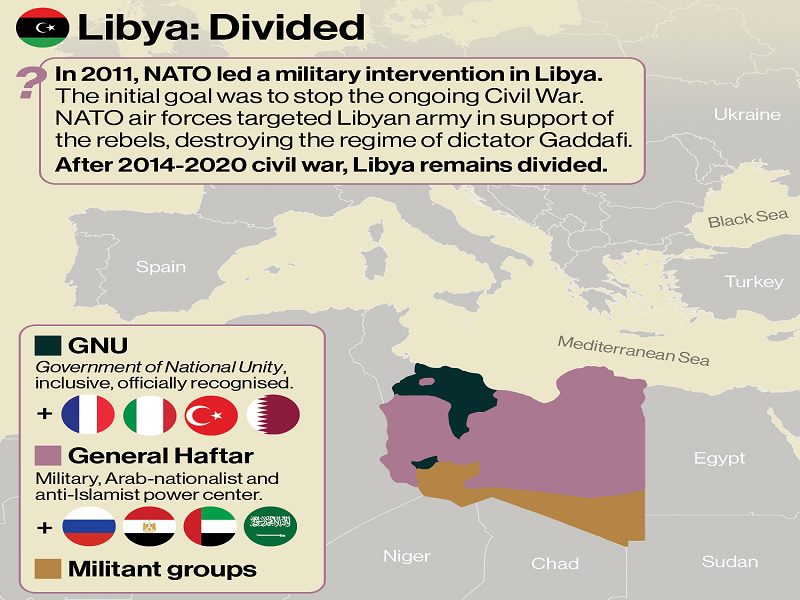
Turkiye threw Albania under the bus to save its unity project in Libya after Ukrainian forces from Western Libya’s Government of National Unity (GNU) in Tripoli attacked a Russian ship in Eastern Libya’s Benghazi Naval Base that’s controlled by the Government of National Stability’s (GNS) Libyan National Army (LNA). A top news source on X that’s reportedly linked to the Turkish State lied that the sea drones came from Albania as a red herring in the hope that the GNS wouldn’t pull out of the new UN-approved roadmap.
Turkiye and the US managed to get both of Libya’s governments to agree to a two-year plan for holding national elections and essentially merging their separate institutions in order to reunify the state. The GNS is unlikely to pull out of this agreement after Ukraine’s GNU-approved provocation, but the incident already threatens to unravel some of the hard-earned relative trust that was gained over the past year. Reports from the BBC and The Arab Weekly make that abundantly clear.
Per the first, “GNU said such activity (as hosting foreign forces and allowing them to use facilities) raises ‘serious fears’ about ‘risks that may result from involving ports and civilian facilities in activities related to external conflicts, and the resulting threat to the lives of citizens and the safety of national facilities and assets’.” That’s incredibly ironic considering that the GNU has been hosting Ukrainian drone teams since this spring at the earliest per the Associated Press. They also attacked a Russian tanker at that time.
Per the second, the GNS’ Prime Minister “had filed formal complaints with the United Nations General Assembly and Security Council… He called on Kyiv to explain its military activities in the country and urged investigators to identify those who operated the drones and provided logistical support, regardless of their nationality or position.” He also “added that the country reserved the right to seek compensation from those responsible.” Ukraine’s latest attack has thus sparked an international scandal.
The Libyan peace process could be derailed if Tripoli doesn’t tell Ukrainian forces to depart since their continued presence is a provocation against the GNS after they just attacked its main naval base in a demonstration of how hostile they are towards Eastern Libya’s Russian-friendly government. Any further attacks against Russian assets in or near Libya could lead to a rupture in relations between the GNU and the GNS, and even if this doesn’t restart the civil war, it could worsen Turkish-Russian tensions.
After all, Turkiye is the GNU’s patron, so it knows that its junior partner is hosting Ukrainian forces that attack nearby Russian civilian and military assets. The GNS’ grey cardinal Khalifa Haftar, the head of the LNA, knows this too as does Russia. For the Libyan peace process to remain on track, Ukrainian forces therefore have to depart so that the GNS can continue balancing between its traditional Russian partner and its new Turkish one, otherwise it risks dependence on Ankara at the expense of its autonomy.
While Turkiye is the GNU’s patron, the US still exerts a lot influence over Tripoli, so much so that the Associated Press’ earlier cited report described the “covert deal” between the GNU and Ukraine as backed by the US as the only Western supporter thereof mentioned by name. The US has invested many diplomatic resources into brokering the new UN-approved roadmap, so if it wants the Ukrainians out of Western Libya to save its unity project even if Turkiye prefers that they stay put, then it’ll get its way.