

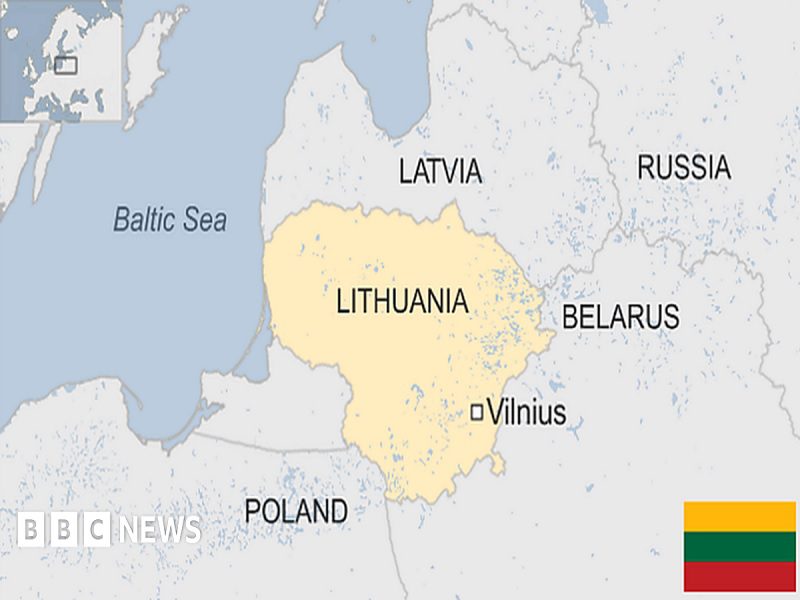
Trump responded in the affirmative when he was recently asked by a Lithuanian reporter whether he’d consider establishing a permanent base there, which the Lithuanian Foreign Minister later confirmed would have its costs covered entirely by Vilnius if Washington agrees to its proposal. This coincided with the Lithuanian Seimas moving forward with lifting the country’s ban on hosting nuclear weapons. Speculation is therefore swirling that Lithuania might host US bases and nukes in the coming future.
The odds of either happening are low, however, since Lithuania is competing with neighboring Poland for both of these “honors” as they’re widely perceived as being in each other’s societies. Trump confirmed last month that “major progress” has been made in talks with Poland over hosting a permanent US base that Warsaw is expected to spend nearly $4.5 billion to construct alongside covering the cost of each US soldier by $15,000 per year. That’s a very enticing offer that Lithuania would struggle to compete with.
After all, Poland is now a $1 trillion economy while Lithuania’s was around $95 billion last year, so Poland could easily outbid Lithuania if it had to. While a permanent US base in Poland would already be provocative enough from Russia’s perspective, one in Lithuania – let alone in both Poland and Lithuania – would be even more so, and Trump might be reluctant to provoke Putin that much. That’s because he’s planning to replicate his successful Belarusian dealmaking with Russia according to a recent report.
It’s beyond the scope of this analysis to elaborate on, but readers can review the preceding hyperlinked analysis to learn more. Moving along, the Polish Deputy Defense Minister claimed in August amidst his ruling liberal coalition’s mixed signaling on Warsaw’s interest in hosting US nukes that “the US doesn’t want to place [nukes] in Poland”, perhaps due to the abovementioned reason. It therefore wouldn’t make sense for the US to ignore Poland, the regional military leader, and base nukes in Lithuania instead.
Lithuania isn’t even part of the elite US-organized Bergen Group that Under Secretary of War for Policy Elbridge Colby described as driving progress toward NATO 3.0, unlike Poland, which is envisaged to play a leading role in European NATO’s containment of Russia under the US’ supervision per this concept. In fact, if Poland succeeds in leading the Intermarium with US support, then it could take the lead in responding to any contingencies in the Baltic States instead of the US feeling obliged to do so right away.
While provocative from Russia’s perspective as was earlier mentioned, post-war NATO-Russian tensions could still become relatively more manageable in that event than they presently are if Trump mediated the creation of a crisis-control channel between the US, Poland, and Russia. That could then help stabilize the new European security architecture that’s forming and possibly lay the basis for other future arrangements that would altogether reduce the risk of war by miscalculation (or false flag provocation).
By contrast, the permanent deployment of US troops and especially nukes to Lithuania would guarantee that post-war NATO-Russian tensions remain high, not to mention keeping the US tied down in Europe. It would therefore go against the spirit of Colby’s grand strategic plans and is accordingly unlikely to happen, barring some unforeseen development(s). Instead of relying on the US or Germany, which already has a base in Lithuania, Lithuania might thus rely more on Poland for its post-war security.